

Most party bike operators cap per-rider weight at a limit that commonly ranges around 275 to 300 pounds; every bike also carries its own published maximum load that can run much higher. If anyone in your group is near that per-rider figure, check the operator’s technical spec or FAQ before you book, and ask about reserving a bench seat instead of a pedaling spot.
TL;DR:
- A manufacturer listed one larger bike’s maximum load at 1,500 kg, covering riders, the driver, and cargo rather than an individual rider’s safe limit.
- Smaller bikes seat 15 to 16 people, while larger models carry 36 to 44; a bench seat often counts as two standard seats.
- Operators may rely on booking disclosures, conduct visual checks, or require advance arrangements; email flagged riders’ details at least a week before the ride.
- Before paying a deposit, request written rider rules and insurance confirmation, and verify that a sober, trained driver handles steering and braking.
Table of Contents
- Typical numeric limits: per-rider weight and per-bike maximum load
- How seating, capacity, and bench seat rules work
- Safety rules, operator responsibilities, and what trust signals to expect
- Enforcement: how operators measure, verify, and handle overweight riders
- Organizer checklist: calculate group weight, seat assignments, and booking actions
- Pedal Power Galway’s perspective on balancing safety with social fun
- How Pedal Power Galway can help: booking links and next steps
- FAQ
- Sources
Typical numeric limits: per-rider weight and per-bike maximum load
Two different numbers matter here, and mixing them up is the most common booking mistake. The first is the per-rider limit, a figure operators set for comfort, pedal mechanics, and seat durability. The second is the per-bike maximum load, a structural figure from the manufacturer that covers the full combined weight of riders, driver, and cargo.
Operator FAQs commonly list one of two per-rider figures:
- A per-seat maximum weight limit often set conservatively by some operators, typically around 275 pounds.
- A higher per-seat maximum weight limit more commonly found on larger pedal-assisted bikes with sturdier seating.
Manufacturer specs tell a different story. A sample technical listing for a larger beer and party bike shows a stated maximum load of 1,500 kg, against a vehicle weight of 630 kg and seating for 15. That gap exists because manufacturers rate the frame and axles for total capacity, while operators apply their own safety margin for passengers shifting weight, pedaling out of sync, or standing up mid-ride.
A manufacturer spec sheet for one party bike model lists a maximum load of 1,500 kg (about 3,307 lb), a figure well above what any single per-rider limit would suggest, since it covers the whole vehicle’s combined load.
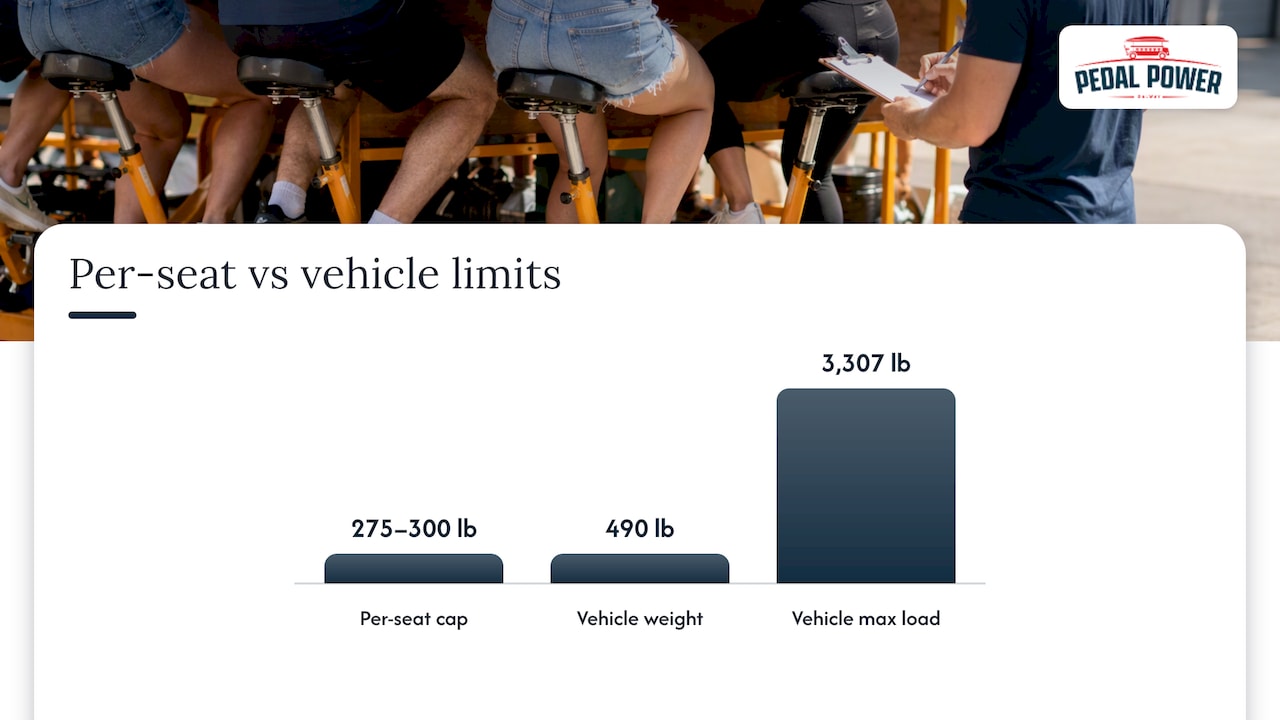
For general scale, a neutral overview of the party bike vehicle class lists a typical length of 2.50 meters, a width of 1.80 meters, and a vehicle weight around 220 kg (490 lb), useful context for why the structural numbers vary so much between compact and large models.
How seating, capacity, and bench seat rules work
Party bikes come in a range of sizes, and seat count drives almost every other decision an organizer makes. Smaller models seat around 15 to 16 people, while the largest bikes used for sightseeing and pub crawl tours can carry 36 to 44 riders, a size range reflected in vehicle options available for larger groups.
- Smaller bikes seating around 15 to 16 people suit stag or hen parties and smaller corporate outings.
- Larger bikes seating typically between 36 and 44 people fit bigger tourist groups, birthday parties, or full office socials.
Not every seat is a pedaling seat; when planning your event, consider using cocktail table sizes for event planners to help organize group meet points and optimize your event furniture layout. Many operators set aside bench seating, non-pedaling spots at the rear or center of the bike, for riders who prefer not to pedal or who exceed a per-rider weight limit. A common policy treats a bench seat as counting for two standard seats in the layout, since it takes up more frame space and shifts weight distribution. Booking a bench spot in advance, rather than hoping one is available at check-in, is the simplest way to accommodate a heavier rider without disrupting the group’s capacity. Choosing a larger bike size outright is another option when several riders in a group are near the per-person limit, since the added structural capacity gives more room for bench allocation.
Safety rules, operator responsibilities, and what trust signals to expect
A reputable operator publishes its safety rules well before you ever show up for a ride, and those rules should cover more than just weight.
- Liability insurance covering the vehicle and all riders during the tour.
- A sober, trained driver who steers and brakes while riders pedal.
- Written rider rules covering conduct, alcohol limits, and safety behavior.
- A signed waiver acknowledging the risks of a group cycling activity.
- Helmet guidance where local conditions or the operator’s policy call for it.
These published rules exist alongside, not instead of, the manufacturer’s structural specs. The manufacturer’s maximum load tells you what the bike can physically carry. The operator’s rider rules tell you how that capacity gets managed on a real tour with real people moving around. Our own safety practices cover insurance, sober drivers, and clear rider rules, and we also publish age requirements setting a minimum age of 12 for day tours and 18 to 21 for evening tours, both useful examples of the kind of trust signals worth checking before you book anywhere.
Pro Tip: Ask any operator for their written rider rules and insurance confirmation before you pay a deposit, not after.
Enforcement: how operators measure, verify, and handle overweight riders
Enforcement varies more than most organizers expect. Some operators simply ask riders to self-declare at booking, others do a visual check at pickup, and a smaller number require any bench or oversize accommodation to be arranged and paid for in advance.
- Disclose any rider near or over the published per-person limit when you book, not on the day of the ride.
- Ask the operator directly whether bench seats or a larger bike need to be reserved ahead of time.
- Request written confirmation of the policy by email so there is no dispute at pickup.
A short, direct email works best: tell the operator your group size, mention that one or two riders may be near or above the per-person limit, and ask them to confirm in writing whether a bench seat, a larger bike, or no change at all is needed.
Pro Tip: Send that disclosure email at least a week before your ride, giving the operator time to adjust seating or vehicle size without a last-minute scramble.
Organizer checklist: calculate group weight, seat assignments, and booking actions
Before confirming any booking, run through a quick capacity check rather than assuming your group will fit.
- List approximate weights for your group, or at least flag anyone likely near the common per-rider weight limits.
- Compare your group size and any flagged riders against the bike’s published seat count and per-rider limit.
- Reserve bench seats or a larger bike size if needed, based on what you find.
- Get written confirmation from the operator of seating assignments and any special policies.
- Confirm day-of details: arrival time, what to bring, dress code, and any accessibility needs.
| Step | Action | Why it matters |
|---|---|---|
| Weight check | Flag riders near 275 to 300 lb | Avoids being turned away at pickup |
| Seat count | Match group size to bike size (15 to 16 or 36 to 44) | Prevents overbooking a smaller bike |
| Bench request | Reserve in advance if needed | Secures a non-pedaling seat ahead of time |
| Written confirmation | Email the operator for policy in writing | Removes ambiguity on the day |
Pedal Power Galway’s perspective on balancing safety with social fun
Clear rules make the social side of a group ride better, not worse. Riders relax more when they know the bike has insurance, a sober driver, and straightforward rider rules rather than vague assumptions. For mixed-weight groups, choosing a larger bike from the start, declaring any heavier riders at booking, and reserving a bench seat rather than leaving it to chance at pickup helps ensure a smooth experience. This approach allows everyone to focus on the music, the stops, and the group itself.
— Pedal
How Pedal Power Galway can help: booking links and next steps
Pedal-powered group tours are available across a range of bike sizes, so mixed-weight groups and large parties both have options for booking.
- Smaller groups fit well on our 15 to 16 seat bikes, detailed on our party bike booking size guide.
- Larger parties of 36 to 44 people can book through our guide to activities for big groups.
- Pub crawl organizers can reserve our 1 3/4 Hour Pub Crawl Tour at €50 per person.
- Groups looking for something different can combine a ride with our Qube Challenge v’s Pedal Power package at €70 per person.
If your group includes riders near a per-person weight limit, email us with your group size and any riders you’d like to flag, and we’ll confirm bench seating or a larger bike in writing before you pay a deposit. Our safety page covers the insurance and rider rules we follow on every tour, and you can start a booking any time through our tours page.
FAQ
What kind of bicycle is suitable for a 150 kg person?
A standard touring or city bicycle rated for heavier riders typically needs a frame and wheel set built for higher loads, which is a separate question from party bike capacity. For group party bikes specifically, a rider near common per-rider limits should ask the operator about bench seating rather than a pedaling seat, since most per-rider pedaling limits sit around 275 to 300 lb.
Can a 300 pound person ride a party bike?
It depends on the operator’s published per-rider limit, which commonly sits at either 275 or 300 lb. A rider at exactly 300 lb should confirm directly with the operator and ask about a bench seat as a backup option before the day of the ride.
Is there a weight limit for riding a party bike?
Yes, most party bike operators publish a per-rider weight limit, commonly 275 to 300 lb, separate from the bike’s overall structural maximum load. Checking both figures, the per-rider limit and the per-bike maximum, before booking helps avoid being turned away at pickup.
What is the maximum weight a party bike can hold?
Total maximum load varies by model and manufacturer, with one published example listing a 1,500 kg maximum load for a larger party bike design. That figure covers the combined weight of all riders, the driver, and cargo, and it is set by the manufacturer rather than the tour operator.
How do bench seats affect party bike weight limits?
Bench seats are non-pedaling spots that many operators reserve for riders near or over the per-rider weight limit, and they often count as two standard seats in the layout. Reserving a bench seat in advance is the most reliable way to accommodate a heavier rider without affecting the rest of the group’s booking.