

Most single party bikes seat around a dozen to a dozen and a half people, though some operators run larger models that hold several dozen for a single event. Operators typically need at least 4 to 10 willing pedalers to get a bike moving, and groups below that threshold usually pay a minimum booking fee instead. Before you commit to a date, confirm the exact seat count, pedal count, and minimum fee directly with the operator.
TL;DR:
- Most party bikes require at least 4 to 10 pedalers to operate safely, with groups below that paying a minimum booking fee or joining larger parties.
- Not all seats on a party bike have pedals; many models feature a mix of pedaling and fixed or non-pedaling seats to accommodate all guests.
- Large bookings with multiple bikes should be reserved 6 to 12 weeks in advance, especially during peak weekends and for bigger event models.
- For groups close to the capacity limit, splitting into smaller bikes often provides a better experience and flexibility, with early planning essential for smooth logistics.
- Confirming details on electric assist, accessibility, and local alcohol policies before booking ensures a safer, more enjoyable ride tailored to your group’s needs.
Table of Contents
- How many seats does a party bike actually have?
- What’s the minimum group size, and what happens if you’re under it?
- How do you split a large group across multiple bikes?
- What’s included in a typical booking, and what should you confirm?
- Operator insights and planner tips from Pedal Power Galway
- How do you estimate the right bike size for your group?
- How do you accommodate mobility issues or children in your group?
- How does peak season affect the size of bike you can book?
- How do different party bike models compare for group size and purpose?
- Planner quick checklist: deciding how many bikes to reserve now
- Booking options and next steps
- Sources
- FAQ
How many seats does a party bike actually have?
Party bikes come in a range of sizes, and the seat count determines almost everything else about your booking, from how many pedalers you need to how the group splits for photos and drinks. The party bike concept dates back to 1997, and most models still follow the same basic layout: a long bench frame with a mix of pedaling positions and fixed seats, built around a central bar or table.
Common configurations include:
- Standard single bikes seating 15 to 16 people, often with fewer pedal stations than total seats.
- Larger single-booking bikes built for corporate events or big parties, holding 36 to 44 people.
- A mix of pedaling seats and bench or non-pedaling seats, so not everyone on board has to pedal.
- Models that run 5 to 6 meters long, per the party bike’s general design, which affects how many can realistically fit and how the bike handles turns.
- Some bikes with electric assist or fully enclosed cabins, which reduce the physical demand on riders and widen who can comfortably join.
The gap between seat count and pedal count matters more than most first-time planners expect. A 15-seat bike might have only 10 positions with actual pedals, meaning several guests can sit back, hold a drink, and enjoy the ride without contributing power. That split is worth asking about early, especially if your group includes people with limited mobility or a few who would rather not pedal in the heat.
What’s the minimum group size, and what happens if you’re under it?
Operators set minimums for a simple reason: a party bike needs enough leg power to move safely, and running a near-empty bike rarely makes financial sense for the business. Guidance on minimum pedalers varies, but experience listings commonly cite figures ranging from about 4 pedalers on the low end to 8 or 10 for a comfortable, steady ride.
If your group falls short of that minimum, you generally have three options:
- Pay the minimum booking fee, which covers the cost as if the bike were full, regardless of your actual headcount.
- Join an open or public tour slot, where your small group rides alongside other bookings to fill the seats.
- Combine your booking with another small group heading to a similar event, splitting the minimum fee between you.
Before you lock in a date, ask the operator four questions: what’s the minimum headcount or fee, what’s the cancellation policy if someone drops out, will the driver help manage the pedaling load on hills, and is an electric-assist bike available if your group skews less athletic. Getting clear answers up front avoids a surprise invoice the week of the event.
How do you split a large group across multiple bikes?
Once your headcount climbs past what one bike holds, the planning shifts from “which bike” to “how many bikes and how do they move together.” A useful starting rule: fill seats first, then balance who pedals. Assign your more mobile or enthusiastic riders to the pedaling positions and reserve non-pedaling seats for anyone less fit, older, or simply not interested in the workout.
Beyond seating, a few logistics deserve attention before the day arrives:
- Check that your meeting point has room to board multiple bikes without blocking foot traffic or other bookings.
- Plan the boarding and unloading sequence, especially if you’re staggering starts for two or more bikes.
- Build in time for photo stops, since groups on multi-bike bookings often want shots together before splitting up.
- Flag any bathroom stops or accessibility needs during booking, not on the day itself.
Timing matters too. A small booking of one bike can often be arranged a few weeks out, but large groups spanning a fleet of bikes should book 6 to 12 weeks ahead, particularly for weekend dates in peak season when availability tightens fast.
Pro Tip: Request a seating map for each bike ahead of time so you can assign pedalers and non-pedaling seats before the event, which speeds up boarding and keeps the pedaling load even.
What’s included in a typical booking, and what should you confirm?
A standard party bike booking covers more than just the seats. Most operators include a few consistent elements, but the details are worth nailing down before you pay a deposit.
- A professional driver or chauffeur who steers and brakes, so no rider is responsible for navigation or safety.
- An onboard speaker system for music, which usually comes standard rather than as an add-on.
- A set route or a menu of stop options, worth discussing if your group has specific venues in mind.
- Basic liability and insurance coverage, which you should ask the operator to explain in plain terms.
Alcohol rules are one area where assumptions get planners into trouble. Open-container and on-board drinking policies vary by municipality, and some regions permit alcohol on party bikes under specific driver and operator rules while others don’t allow it at all. Confirm your local rules and the operator’s own policy before you plan a route around drinking.
Weather policy and accessibility also deserve a quick check, along with whether electric-assist bikes are available for hilly routes. These details rarely show up on a booking page but can change your group’s experience significantly.
Operator insights and planner tips from Pedal Power Galway
Booking the right size bike comes down to matching your group to the operator’s actual fleet, not a generic industry average. Some operators recommend thinking in terms of two main tiers: smaller 15-seat bikes for standard group outings, and larger single-event bikes built for 36 to 44 people for big parties or corporate functions.
A few practical notes worth building into your planning:
- Reserve further ahead for peak dates. Large groups and weekend slots in busy months fill faster than weekday bookings.
- Put down a deposit as soon as your headcount is roughly confirmed, since availability on bigger bikes is limited.
- Ask guests to dress for pedaling, meaning layers and comfortable shoes rather than anything restrictive.
- Designate who’s pedaling before the day arrives, especially for groups mixing fit and less active guests.
- Pick a meeting point with enough space for your group to gather and board without crowding a sidewalk or doorway.
These steps sound small individually, but together they’re the difference between a smooth boarding process and a 20-minute scramble before the bike even leaves the curb.
How do you estimate the right bike size for your group?
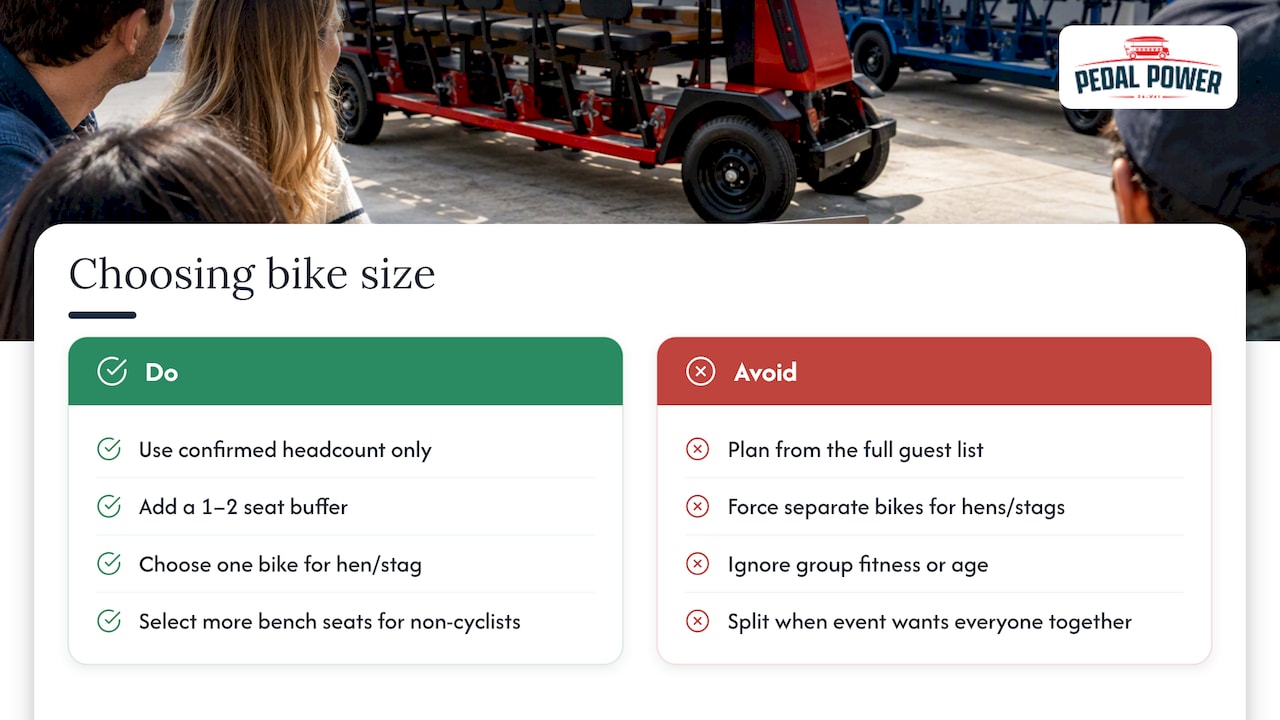
Start with your confirmed headcount, not your guest list. Invitations always draw a few no-shows, so build your bike size around the number who have actually said yes, with a small buffer of one or two seats if your event type tends to draw late additions.
Event type matters as much as raw numbers. A hen or stag party usually wants everyone on one bike for the shared experience, even if that means paying a bit more per seat on a larger model. A corporate team day, by contrast, might split naturally into two smaller bikes if you want separate teams to bond independently before regrouping.
Demographics shift the calculation too. A group heavy on non-cyclists or older guests benefits from a bike with more non-pedaling bench seats relative to pedal stations, since you’ll have fewer people actually powering the ride. A younger, fitness-oriented group can lean toward a model with more pedal positions, since the physical side of the experience is often part of the appeal rather than a drawback.
When your numbers sit right at the edge between one bike and two, consider the event’s purpose. A milestone birthday or hen party usually wants to stay together, worth the minor sizing compromise. A larger graduation gathering or office social, where people will naturally cluster into smaller conversations anyway, splits more comfortably.
How do you accommodate mobility issues or children in your group?
Not every guest on your list will want to pedal, and some may not be physically able to. The good news is that most party bike models already build in non-pedaling seats, so guests with mobility limitations can join the ride without being asked to contribute leg power.
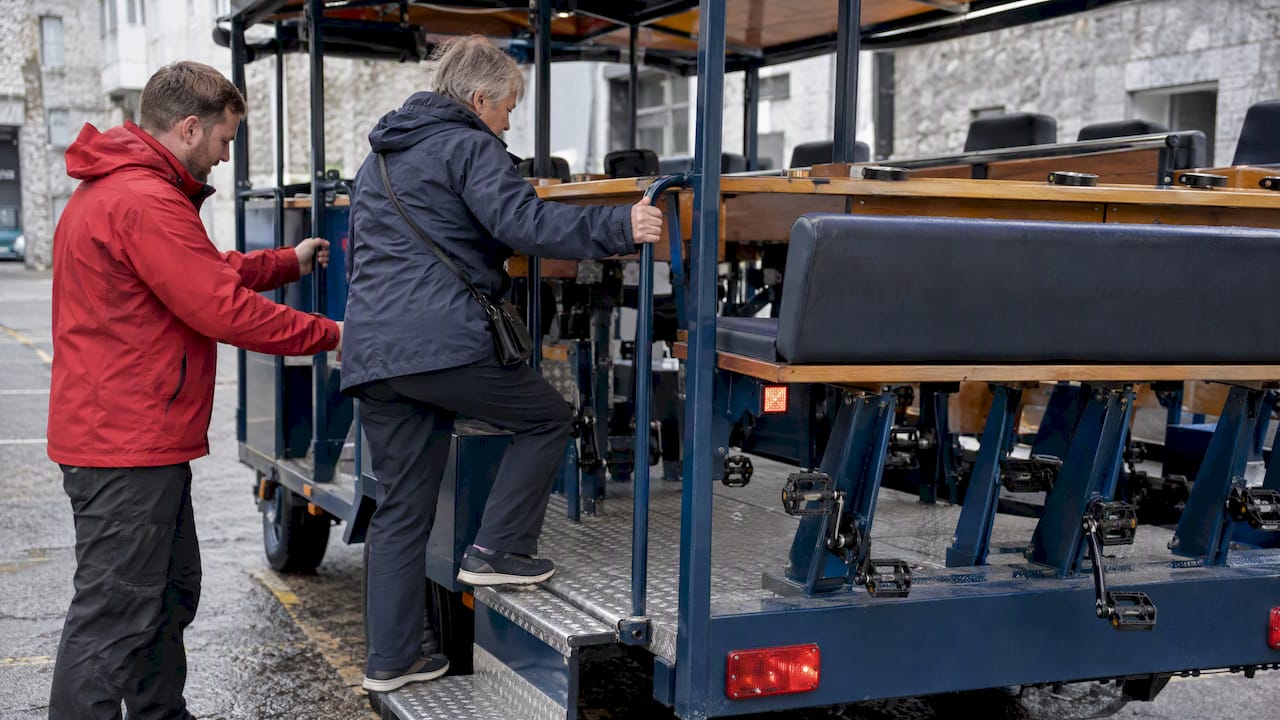
When you book, mention any specific needs directly rather than assuming the operator will ask. Flag anyone using a wheelchair or mobility aid, since boarding a raised bike platform can require assistance or a different access point. Mention any guest with a heart condition, recent injury, or pregnancy, since the operator can seat them away from the pedaling zone and near the easiest exit point.
Children bring a different set of questions. Policies on minimum age vary by operator and often tie to local safety rules, so confirm whether kids are permitted at all before you build an event around a mixed-age guest list. If children are allowed, ask whether they need to sit in a non-pedaling seat and whether a booster or harness is available.
The simplest approach for a mixed group: seat pedalers toward the center of the bike where the mechanism does the most work, and keep mobility-limited guests, children, and non-pedaling guests toward the ends near the boarding steps. It keeps the ride balanced and makes getting on and off faster for everyone.
How does peak season affect the size of bike you can book?
Availability tightens considerably once you move into peak booking windows, and the effect is more pronounced for larger bikes than smaller ones. A single 15 or 16 seat bike is easier for an operator to slot into a busy calendar than a 36 to 44 seat model, which usually needs to be blocked out well in advance for a single group.
Weekend afternoons and evenings during warmer months draw the heaviest demand, largely from hen and stag parties, birthday groups, and corporate outings scheduling team events outdoors. If your date falls in that window, book as early as you can, ideally the 6 to 12 week range mentioned earlier for larger groups, and even earlier if you have a fixed date you can’t move.
Shoulder seasons and weekday slots offer more flexibility, both in terms of which bike sizes are available and how much notice you need to give. If your group size is flexible, ask the operator whether shifting to an off-peak day opens up a larger bike you’d otherwise have to split into two bookings.
Seasonal weather plays a role too. Operators in regions with cooler or wetter months may have reduced availability outside the warmer season, or may offer enclosed or electric-assist models as an alternative when open-air bikes are less practical.
How do different party bike models compare for group size and purpose?
Not every bike suits every event, and matching the model to your purpose matters as much as matching it to your headcount.
Smaller bikes in the 15 to 16 seat range work well for hen and stag parties, birthday groups, and casual friend outings where everyone wants to be part of the same conversation and the same photos. These models are also the easiest to book on shorter notice, since operators typically run more of them.
Larger 36 to 44 seat bikes suit corporate events, large milestone celebrations, or any gathering where splitting the group across multiple smaller bikes would break up the shared experience organizers are trying to create. These bikes need more lead time to book and usually command a higher per-person rate, but they avoid the logistics of coordinating two or three bikes moving through the same route together.
Electric-assist and enclosed models, as described in general party bike design overviews, suit groups with a wider range of fitness levels or events running in less predictable weather. They reduce the physical demand on pedalers and keep the ride comfortable even when not everyone on board is contributing power. If your group is mixed in age or ability, asking whether an electric-assist option exists is worth the extra question during booking.
Planner quick checklist: deciding how many bikes to reserve now
If your headcount is confirmed, sizing your booking is a three-step job: lock the final number, ask the operator about pedaling seats and any minimum fee, then pay the deposit and confirm your meeting point. Call the operator directly for anything involving multiple bikes or a non-standard group; book online only for a straightforward single-bike reservation.
— Pedal
Booking options and next steps
Some operators run both standard 15-seat bikes and larger single-event bikes built for 36 to 44 people, so most groups fit one booking rather than splitting across two reservations. Whether you’re organizing a 1 3/4 Hour Pub Crawl Tour for a smaller crew or a bigger single-event hire for a corporate outing or milestone party. The fastest path is to contact the operator directly with your confirmed headcount.
A few ways to move forward:
- Browse the full tours overview to compare package options by group size and event type.
- Pair your ride with a themed add-on, such as the Qube Challenge V’s Pedal Power combination for team events.
- Reach out directly if your group needs a custom split across bikes or a combined booking for a large party.
Deposits confirm your date and bike size, and the operator can walk through exact seat and pedal counts for your specific headcount before you pay.
Sources
Background on party bike design comes from the Wikipedia entry on party bikes, with capacity and booking details drawn from TripAdvisor and Booking.com listings. Planners managing shared-space logistics may also find value in this capacity planning guide and this group booking workflow guide.
- Party bike — Wikipedia
- WEE TOAST: All You SHOULD Know Before Going (2026)
- Party Bike Tour of Belfast
FAQ
How many pedalers does a party bike need to move?
Most operators require somewhere between 4 and 10 pedalers depending on the bike’s size and layout, according to experience listings covering typical minimums. Groups below that threshold usually pay a minimum booking fee instead of being turned away.
Do all the seats on a party bike have pedals?
No, most party bikes mix pedaling positions with fixed bench seats, so not every guest needs to pedal. A 15 to 16 seat bike commonly has fewer actual pedal stations than total seats, leaving room for guests who’d rather sit back.
How far ahead should you book a party bike for a large group?
A single standard bike can often be booked a few weeks out, but larger bookings spanning multiple bikes or a big single-event hire are best reserved 6 to 12 weeks ahead, especially for peak-season weekends as noted in fleet capacity listings. Booking early also improves your odds of securing a larger model if your group grows.
Can you combine two small groups to meet a party bike’s minimum?
Yes, combining a small group with another small booking is a common way to meet an operator’s minimum headcount without paying the full minimum fee alone. Ask the operator directly whether they can pair your group with another booking on the same date and route.
What’s a typical seating range for party bikes used at events?
Single bikes commonly seat 15 to 16 people, while larger models built for single-event hires can hold 36 to 44 guests. Confirm exact seat and pedal counts with your chosen operator, since layouts vary by model.