

A new team needs two things before it needs a trophy: a clear picture of how it will work, and a shared experience that gets people talking as people. The best way to deliver the second is a single, well-chosen group outing with built-in conversation, and in Galway we run exactly that: a guided ride on a large open-air pedal bike seating up to 44, with music, stops and optional challenges such as the Qube Challenge or an escape room.
TL;DR
- Start with structure: goals, roles and ground rules first, then a social activity that supports them.
- Keep new teams small, and match the activity to group size, time and everyone’s comfort level.
- Pick something where people sit side by side, move and talk, rather than a forced speech-based exercise.
- Always leave time to debrief: the learning comes from the conversation afterwards.
- In Galway, our pedal tours (from €50 per person) and our Qube Challenge or escape room combinations (€70 and €60 per person) work for teams of up to 44.
Table of Contents
- Why new teams are different
- Step one: get the team started properly
- Choosing an activity: size, time, budget, comfort
- Quick icebreakers for the first meeting
- The shared outing: where bonding really happens
- Three formats that suit a new team in Galway
- Make it count: the debrief
- Planning the day without the headaches
- What to book
- Our view
- FAQ
- Sources
Why new teams are different
A team that has worked together for years has habits, history and shortcuts. A new team has none of that. Nobody knows who is quick to speak up, who needs time to think, or who to ask for help. That is why the activity you choose for a new team should do something different from the one you would pick for an established one.
One HR guide for 2026 separates two goals. Team building targets how work gets done: roles, handovers, decisions. Team bonding targets how people feel about each other. It also notes that running an icebreaker with a team that has worked together for years is a common mistake, because people find it patronising. For a brand-new group the reverse is true: bonding is the missing ingredient, and an icebreaker is exactly right.
Researchers back the point about purpose. Dr Andreea Corbeanu of the University of Limerick told the Irish Examiner that an activity disconnected from the team’s needs can be seen as box-ticking. So before booking anything, be clear about what your new team actually needs.
Step one: get the team started properly
The activity is the second move. The first is a kick-off that gives people something solid to stand on.
MIT Human Resources guidance on new teams recommends keeping new teams small, no more than ten people, so members can build connection and depend on one another. It says a kick-off should set out goals, mission and structure, and that the team should agree a mission statement, S-M-A-R-T goals (specific, measurable, achievable, relevant and time-bound), roles and responsibilities, and explicit ground rules. Those ground rules should cover how you communicate in meetings, between meetings, and how you treat each other.
The Penn State Team Science Toolkit offers a similar running order for a kick-off meeting:
- Open with an icebreaker.
- Let members introduce themselves and their expertise.
- Define the purpose and scope of the work.
- Clarify roles.
- Present a timeline with milestones.
- Ask for commitment, for example through a signed team agreement.
Do this in the first week or two. Then book the social experience, so that the people who now know what they are doing together can find out who they are doing it with.
Choosing an activity: size, time, budget, comfort
Four questions narrow the options quickly.
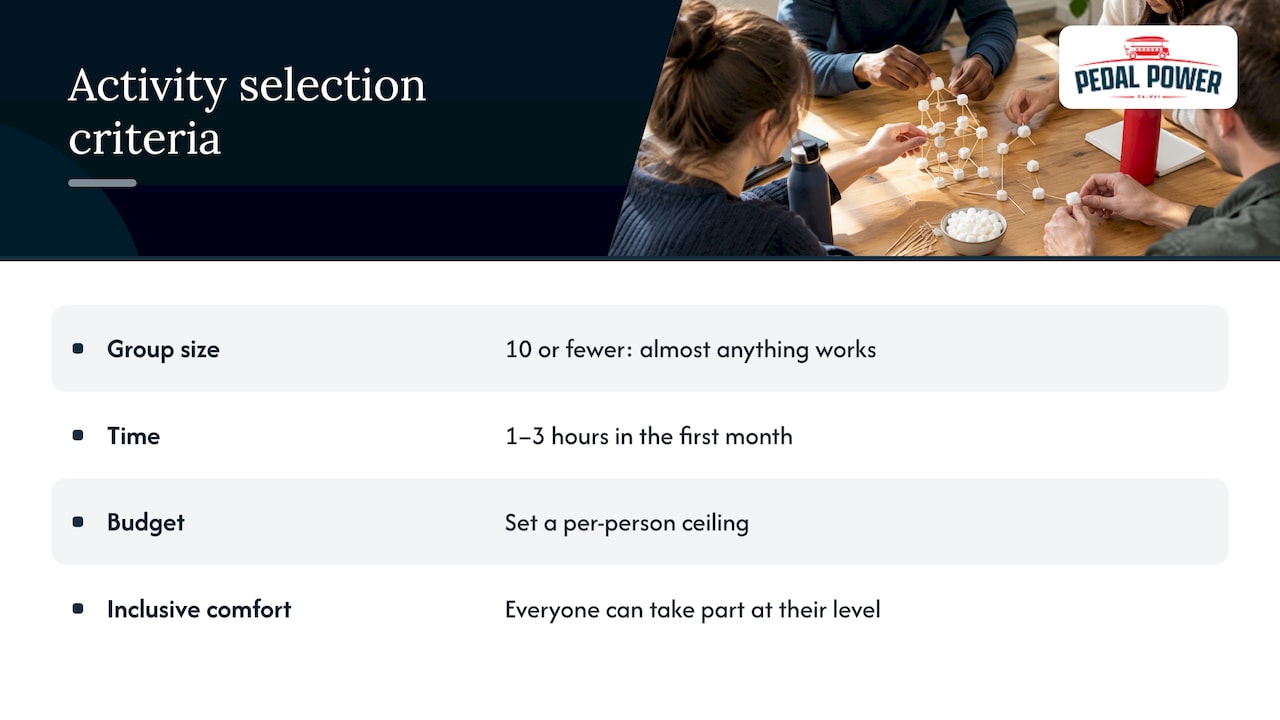
How many people? Two Truths and a Lie suits a small group, while scavenger hunts and moving games suit larger ones, according to Asana’s guide to team games. If your new team is ten people or fewer, almost anything works. If you are onboarding a whole intake or merging two departments, you need something that scales without splitting the room into cliques.
How much time? A quick icebreaker takes minutes. A longer collaborative challenge takes one to two hours. A full away day takes a day. For most new teams, one to three hours in the first month is the sweet spot: long enough to relax, short enough to protect the working week.
What does it cost? Budget per head matters because it multiplies. Fix a per-person ceiling before you start browsing.
Who might feel left out? This is the one organisers forget. Dr Corbeanu warns that overly physical, highly competitive or socially demanding activities can leave people with different abilities, health needs or personality types feeling anxious or marginalised. Choose an activity where everyone can take part at their own level, such as sitting, pedalling or simply riding along, and where competition is light. Asana’s inclusion tips are to consider all abilities, remember that introverts often prefer smaller groups, and gather input through an anonymous poll.
Quick icebreakers for the first meeting
You do not need a day out to start. For the kick-off meeting itself, a few short exercises do the job:
- Ten Things in Common. Pairs or small groups find ten things they share in three minutes, then the room votes for the most surprising list, as described in Qualee’s onboarding guide.
- Name Juggling. Five or more people pass a ball while saying names. It takes a few minutes, per SessionLab’s activity library.
- Human Bingo. Everyone gets a card of traits and has to find a colleague who matches each square. It gets large groups moving and talking.
For more ideas sorted by group size, see our guide to group activity icebreakers that actually get people talking, and our team bonding questions for conversation prompts you can use over a coffee or on the ride.
The Penn State toolkit adds the rules that make icebreakers land: a clear objective, simple instructions, good timing, a facilitator who has practised, and a link back to the team’s goals. Demonstrate first, debrief without demanding feedback, and afterwards connect the exercise to the project.
The shared outing: where bonding really happens
Icebreakers get names into heads. A shared experience gets people laughing, helping each other and making stories they refer to for months. The effect is well known to anyone who has watched a quiet new hire loosen up on a day out.
The Irish Examiner piece describes how companies are moving beyond the occasional team lunch toward experiences that spark collaboration and build soft skills. Joya Kuin of Meitheal Mara in Cork says dragon boat racing works for corporate teams because it combines the water, exercise, networking and a healthy dose of competition, with 16 paddlers per boat needing to pull at the same pace. The principle behind that is one a pedal bike shares: everyone moves together, and the group only works if people coordinate.
That is the idea behind a pedal-powered group tour. On one large open-air bike, a new team sits shoulder to shoulder, with music playing and a guide leading the way. Nobody has to perform. Conversation happens in the gaps, at the stops and over the games, which is much easier than talking across a boardroom table.
If you are planning around Galway, our corporate away day ideas for Ireland and guide to team building activities in Ireland set out options by group size. For being outdoors, see our notes on outdoor team building in Ireland.
Three formats that suit a new team in Galway
| Format | Typical length | Price (as published) | Best for |
|---|---|---|---|
| 1 3/4 Hour Pub Crawl Tour | 1 3/4 hours | €50 per person | A relaxed first social for a mixed team |
| Pedal Power v’s Escape Room | Bike tour plus escape room | €60 per person | Teams who want to solve something together |
| Qube Challenge V’s Pedal Power | Bike tour plus Qube Challenge | €70 per person | Trust-building and light competition |
Our tours can be customised, and the bikes seat up to 44, so a single booking can cover a large intake without splitting people up. See our page on team socials in Galway for 36 to 44 people if your group is large.
The Qube Challenge route
For a team that has just formed, the Qube Challenge pairs the ride with a puzzle-style teamwork challenge. Our guide to the Qube Challenge for team trust in 60 to 90 minutes explains how it works, and what to expect before you book covers the practical details.
The escape room route
Escape rooms give a new team a shared goal, a clock and a reason to listen to each other. Combined with the bike tour, they fill an afternoon without dragging on.
The classic tour
If your team is still finding its feet, the shorter tour is the gentlest start: music, sights and stops with no pressure to perform. We also have longer routes, including the 3 Hour Pub Crawl Tour at €70, listed on our tours page.
Make it count: the debrief
The outing is not the end of the work. Kathleen Halligan, a chartered work and organisational psychologist quoted in the Irish Examiner, says the real value comes from reflecting afterwards: how the team worked together, what could be done better, and how that applies to everyday work. She advises being intentional about the outcome you want, running activities during work hours rather than after, and using challenge by choice instead of mandatory participation.
HavernHR’s guide goes further and says the debrief is the activity, reserving at least a quarter of total time for it. It suggests four questions:
- What happened?
- What did you notice about how you worked together?
- Where does that pattern show up in real work?
- What is one thing to change this week?
For a 90-minute outing, that is about 20 minutes. Do it at the last stop, or at the next team meeting, while the memory is fresh.
Planning the day without the headaches
A short checklist saves most of the trouble:
- Pick a weekday or a work-hours slot so no one has to choose between the team and family.
- Invite everyone, force no one. Make participation a choice and give a quiet option for anyone who prefers it.
- Tell people what to expect in advance: duration, meeting point, dress for the weather.
- Set one aim. For example: “By the end, everyone knows three things about every teammate.”
- Book ahead for larger groups, especially in the busy season.
If some of the team travels to Galway, an overnight stay turns the outing into a proper away day. Planning a team break outside the city? This guide to group accommodation in Meath for team breaks shows how to approach it.
For a longer list of ways to organise a day, our custom group activities in Galway page has ideas for every crew.
What to book
If your team is new and you are in or near Galway, our Pedal Power tours give you a ready-made outing: a large open-air bike, a guide, music, stops and games, with a Qube Challenge or escape room option for teams who want something to solve together. The 1 3/4 Hour Pub Crawl Tour is €50 per person, the escape room combination is €60 per person and the Qube Challenge combination is €70 per person. You can look through the full list of tours or go straight to our home page to enquire about a custom date and group size.
Tell us the size of the group, how long you have and what you want people to take away, and we will shape the tour around it.
Our view
We have built Pedal Power Galway around one belief: people bond fastest when they do something together that is a bit unusual and a lot of fun.
A new team does not need a lecture on trust. It needs a shared afternoon where nobody is on stage. On our bikes, up to 44 people sit together in the open air, with music, a guide and games built in. Conversation starts on its own.
That is why we offer the Qube Challenge and escape room combinations alongside the classic tour. Some teams want a relaxed first social. Others want a puzzle to crack together. Either way, the format gives everyone a role and a reason to talk to someone they met last week.
Our advice to organisers is simple: settle goals and roles first, pick one outing that suits the whole group, and leave time afterwards to talk about what you noticed. We will take care of the ride.
Pedal
FAQ
How do you start a new team?
Begin with a kick-off that covers goals, roles, a timeline and ground rules, and open it with an icebreaker. MIT’s guidance suggests keeping new teams to ten people or fewer. After that, schedule a social activity so the relationships catch up with the plan.
How soon should a new team do a team-building activity?
A short icebreaker belongs in the first meeting. A longer outing works well within the first month, once people know each other’s names and roles. That way the activity builds on a basic structure rather than replacing it.
Is team building worth it?
It depends on the purpose. Dr Corbeanu cites a 2024 study finding that occasional team lunches and drinks have limited influence on measurable performance, and says activities work best when tied to what the team needs. Choose an activity with a clear aim and debrief it, and the value is far greater.
What group size can your bikes take?
Our large open-air bikes seat up to 44 people, so a whole department or a new intake can ride together. Tours can be customised for your group, so tell us the numbers when you enquire.
Sources
- Irish Examiner: Inter-Firm Dragon Boat Challenge builds teams
- MIT Human Resources: Important Steps When Building a New Team
- Penn State CTSI Team Science Toolkit: Team Launch
- HavernHR: 20 Team Building Activities That Actually Work
- Qualee: 7 Onboarding Ice Breakers for New Team Members
- SessionLab: 57 team building activities
- Asana: 45 team building games