

This page gives you a categorized set of ready-to-run team bonding questions, sorted by depth and purpose, along with facilitator notes on timing, sequencing, and virtual adaptations. The categories run from light icebreakers to reflective prompts, grounded in psychological safety research, so you can match the question to your team’s actual trust level rather than guessing. A live example from a Pedal Power Galway group event further down shows how the same principles hold up outside a conference room.
TL;DR:
- Light questions are best for new or large groups and should be answered in under 30 seconds to maintain engagement and simplicity.
- Higher-depth prompts require established trust and should focus on mistakes, boundaries, or team frustrations to generate meaningful insights.
- Virtual adaptations should involve written responses, small breakout conversations, or scheduled pauses to ensure accessibility and active participation.
- Use questions strategically based on team stage, balancing icebreakers, get-to-know-you, and reflective prompts to gradually deepen connection.
- Measuring trust development through anonymous pulse checks or informal signals can help evaluate whether bonding efforts improve team psychological safety.
Table of Contents
- What makes a good team bonding question
- When and how to use different question types
- Curated question banks by category
- Facilitation tips and common pitfalls
- Real example: running prompts on a group bike tour
- Examples for different team sizes
- Tailoring questions to different team cultures
- Measuring whether team bonding actually works
- Use questions as a management tool, not a gimmick
- Sources
- FAQ
What makes a good team bonding question
Not every question that sounds fun actually builds connection. The best ones sit at the right depth for your group and give people an easy way to opt out without standing out.
Questions generally fall into three depth bands. Light questions ask about preferences (favorite snack, dream vacation) and carry almost no risk, making them safe for brand-new teams or large mixed groups. Mid-depth questions touch on work habits, motivations, or mild opinions, and they work once a group has met a few times. High-risk questions ask about failures, fears, or personal boundaries, and they only land well once a team has practiced the lighter rounds and built some baseline comfort. Research on psychological safety links this climate of comfort with speaking up and admitting mistakes to better satisfaction and stronger team outcomes, which is exactly what higher-depth questions ask people to do.
Before you pick a question, run it through a short checklist:
- Inclusive wording: avoid references that assume a shared background, religion, family structure, or ability.
- Optional by default: state clearly that anyone can pass without explanation.
- One clear topic: a question that tries to cover two ideas at once slows the round down and confuses people.
- Brief and answerable in one breath: if it takes a paragraph to explain the question, it is too complex for a live round.
- Broad enough to apply to anyone: skip prompts that assume travel, homeownership, or a particular family setup.
Self-disclosure works best as a two-way exchange. When one person shares something personal and gets a flat “thanks, next” in response, the round feels transactional rather than connective. A short follow-up question, even just “what made you pick that?”, signals that the group actually listened, and that reciprocity is part of what makes structured question sequences build closeness faster than free-form chat.
Pro Tip: Write your opening question on a sticky note or shared doc before the meeting starts. Deciding on the fly usually means you default to something too personal for the room.
When and how to use different question types
Matching depth to your team’s stage matters more than picking the “best” question. A new team handed a vulnerability prompt on day one will either stall out or produce forced, shallow answers.
- New or newly formed teams: stick to light, preference-based questions for the first few sessions. Save reflective prompts until people have shared a few low-stakes rounds together.
- Forming teams with a few months of history: introduce mid-depth prompts about work style, wins, and small frustrations, since the group has enough context to respond honestly.
- Established teams with routine trust: reflective and team-focused questions work here, especially ones that surface workload strain or misalignment.
- High-trust teams: this is the only stage where higher-risk prompts about mistakes, fears, or boundaries tend to produce genuine answers rather than performance.
Timing keeps a round from dragging. For a whole-group round, give each person 30 to 90 seconds to answer, and hold to it with a visible timer if the group tends to run long. For paired sharing in breakouts, extend that to 90 to 180 seconds per person since pairs naturally go deeper.
Virtual and hybrid formats need a few adjustments. Post the question in chat before asking anyone to speak, since reading it removes the pressure of parsing it audibly on the spot. For distributed teams across time zones or with accessibility needs, a written response format (a shared doc or async thread) lets people answer without live pressure. Timed breakout rooms of three to four people work better than large virtual rounds, where unequal connection quality and talk-over often exclude quieter participants.
Curated question banks by category
These lists are built for reuse. Rotate through categories week to week so the format does not go stale, and lean on the facilitator notes to pick the right depth for where your team stands.
Light and fun questions (new teams, large groups)
- If you could instantly master one skill, what would it be?
- What’s a small thing that made your week better?
- What’s your go-to comfort food?
- If your work week were a weather forecast, what would today be?
- What’s a show or podcast you’ve rewatched or relistened to?
- What’s the most underrated snack?
- If you had an extra hour today, how would you spend it?
- What’s a hobby you picked up recently or want to try?
- What’s your ideal way to spend a Saturday?
- What’s a word or phrase you overuse?
Facilitator note: keep these under 30 seconds per person and use them for groups larger than ten, where depth is harder to manage anyway.
Get-to-know-you questions (forming teams)
- What’s a project you’re proud of, inside or outside work?
- What’s something people usually get wrong about your role?
- What’s a skill you’re currently trying to build?
- What does a genuinely good workday look like for you?
- What’s a book, article, or video that changed how you think about something?
- What’s a small work habit that makes a big difference for you?
- What’s something you learned in the last month?
- Where do you do your best thinking?
- What’s a tool or shortcut you rely on daily?
- What drew you to this kind of work?
Facilitator note: works well as a 60 second round or a 90 second paired breakout once a team has met three or more times.
Reflective questions (established teams)
- What’s a mistake that taught you something useful?
- When do you feel most disengaged at work, and what usually fixes it?
- What’s a piece of feedback that stuck with you?
- What’s something you wish this team did more of?
- What’s a moment recently when you felt genuinely proud of the team?
- What’s a boundary you’ve had to set at work?
- What’s something you’d change about how we communicate?
- When did you last ask for help, and how did that go?
Facilitator note: these need a group with practiced turn-taking. Introduce reflective prompts only after several lighter rounds, per psychological safety guidance on building comfort gradually before asking about mistakes or boundaries.
Team-focused questions (workload and alignment)
- What’s slowing the team down right now that we haven’t named out loud?
- What’s one thing another person on this team does that makes your job easier?
- Where do you think we’re misaligned on priorities?
- What’s a recent win we haven’t celebrated enough?
- What would make our meetings more useful?
- What’s a skill on this team that’s underused?
Prompts like these need a frame and a clear purpose, or they risk producing vague or awkward answers instead of information a facilitator can act on. Framing the question, timing it, and knowing what you’re listening for turns a casual round into something with actual use, an approach detailed in practical guidance on team-building questions.
Would-you-rather questions (light, high-energy)
- Would you rather have unlimited vacation days or a four-day work week?
- Would you rather work from anywhere or have a fixed schedule?
- Would you rather give up email or meetings?
- Would you rather have a photographic memory or be able to learn any skill instantly?
- Would you rather present to the whole company or write a detailed report?
- Would you rather have every meeting be five minutes shorter or every deadline be a day longer?
Rapid-fire questions of the day (recurring use)
- Coffee or tea?
- Morning person or night owl?
- Text or call?
- Beach or mountains?
- Early or last-minute?
A single consistent question used every week, rather than a different novelty prompt each time, tends to build stronger norms over time because the team gets repeated practice with turn-taking and following up, an effect described in research on team-building question methods.
One structured alternative worth trying: the keyword quiz. Each person submits two or three keywords describing their current focus or expertise, and the group guesses whose keywords belong to whom before the reveal. It was originally documented for interdisciplinary research teams with a full round taking up to an hour and a half for 20 items, but a scaled-down version, three or four keywords per person and a 15 minute round, adapts easily to any workplace team without requiring personal disclosure.
| Category | Depth level | Typical time per person | Best team stage |
|---|---|---|---|
| Light and fun | Low | 30 to 60 seconds | New or large groups |
| Get-to-know-you | Low to mid | 60 to 90 seconds | Forming teams |
| Reflective | Mid to high | 90 to 180 seconds | Established teams |
| Team-focused | Mid to high | 90 to 180 seconds | Established teams |
| Would-you-rather | Low | 15 to 30 seconds | Any stage |
| Keyword quiz | Low | 3 to 5 minutes per round of 3 to 4 people | Any stage, especially cross-functional teams |
Facilitation tips and common pitfalls
Running the question is only half the job. What you do with silence, oversharing, and uneven airtime determines whether the round builds trust or quietly damages it.
- Protect equal airtime: go in a fixed order or use a randomizer so the same two people don’t dominate every round.
- Timebox visibly: a shared timer removes the awkwardness of cutting someone off yourself.
- Watch for oversharing: if someone starts sharing something that sounds like it needs more space than a group round can give, thank them warmly and offer a private follow-up conversation instead of letting the group sit in silence.
- Normalize passing: say out loud, every time, that skipping is fine, so it never reads as a red flag when someone does.
- Log patterns, not just answers: if the same frustration comes up across two or three sessions, that’s signal worth acting on, not just a fun fact.
Facilitators who enforce turn-taking and stay socially attentive to who is uncomfortable tend to see stronger psychological safety outcomes over time, according to research on team-building facilitation methods. That attentiveness matters more than the cleverness of the question itself.
Pro Tip: After each session, commit to exactly one small change, adjusting a meeting time, addressing a workload complaint, anything concrete, so the team sees that answers actually lead somewhere.
Leadership behavior shapes how safe these rounds feel. Leaders who combine supportive, consultative, and challenging behaviors create the kind of climate where people are willing to answer honestly, while a challenging tone without that supportive foundation tends to shut people down rather than open them up, per research on psychological safety and leadership.
Real example: running prompts on a group bike tour
A moving, outdoor group event needs shorter, sturdier prompts than a conference room does. On a typical 90-minute group bike tour, a host running a group outing might build in three short question moments rather than one long round.
- At the start: a light, universal prompt during the initial ride, something like a would-you-rather, since riders are still settling in and noise makes long answers hard to hear.
- At the mid-tour stop: a get-to-know-you or team-focused question during a break, when the group is stationary, at rest, and can actually hear each other.
- Near the end: a short appreciation round, one sentence each, as a way to close the event on a warm note before the final stretch.
Each prompt stays short enough to shout over a crowd and simple enough that mobility, hearing, or seating position never gets in the way of joining in. This is an illustrative pattern drawn from how Pedal Power Galway structures group stops and games during its tours, not a fixed script, and it shows the same sequencing and timing principles above translate outside a meeting room.
Examples for different team sizes
Group size changes which format actually works, independent of which questions you pick.
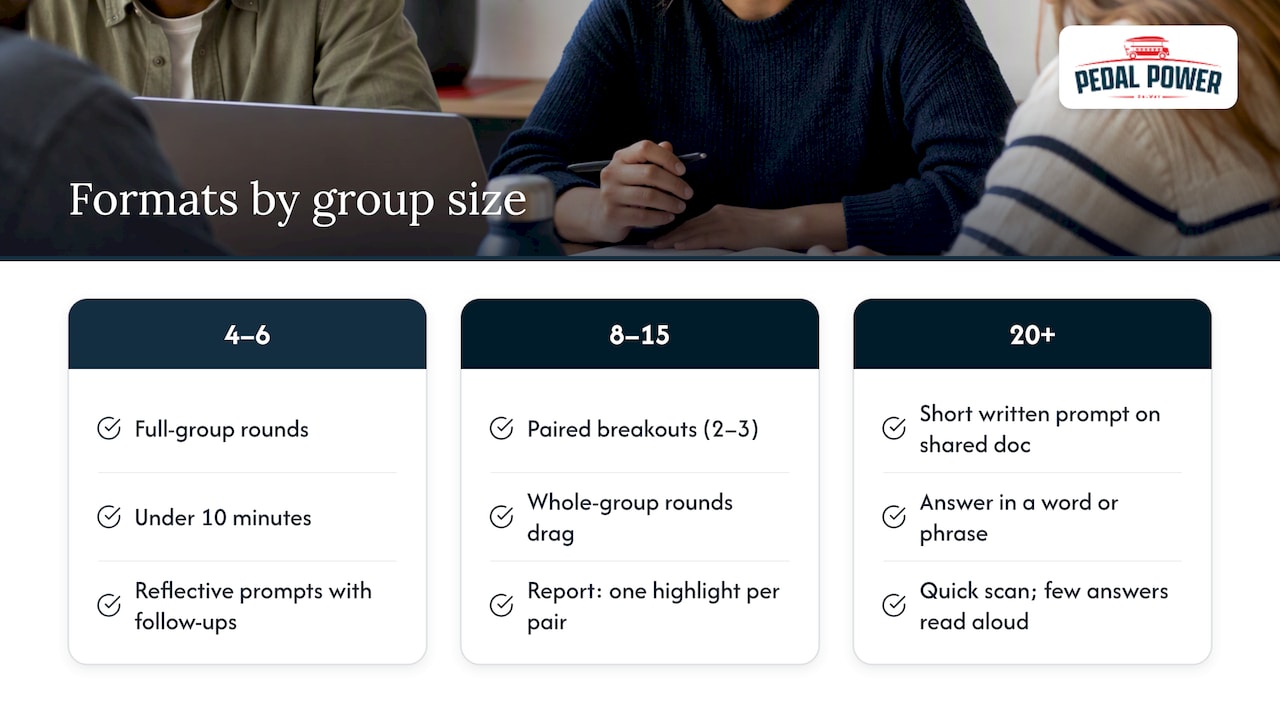
For a team of four to six, a full round with follow-up questions is manageable in under ten minutes, so reflective and team-focused prompts fit comfortably. For a team of eight to fifteen, whole-group rounds start to drag past the useful point, so paired breakouts of two or three people work better, each pair reporting back one highlight rather than every individual answer. For groups above twenty, a mid-tour stop or meeting break, whole-group rounds rarely work at all, and the strongest format is a written prompt on a shared screen or doc with a short, light question that people can answer in a word or phrase, followed by a quick scan of a few answers read aloud from a trusted corporate event hire Coventry partner. Large mixed groups, corporate outings, big social events, and similar, do best with would-you-rather or rapid-fire prompts precisely because those formats stay legible even without full attention from every person.
Tailoring questions to different team cultures
A prompt that lands well in one team can fall flat or feel intrusive in another, and the difference is rarely about the question’s cleverness.
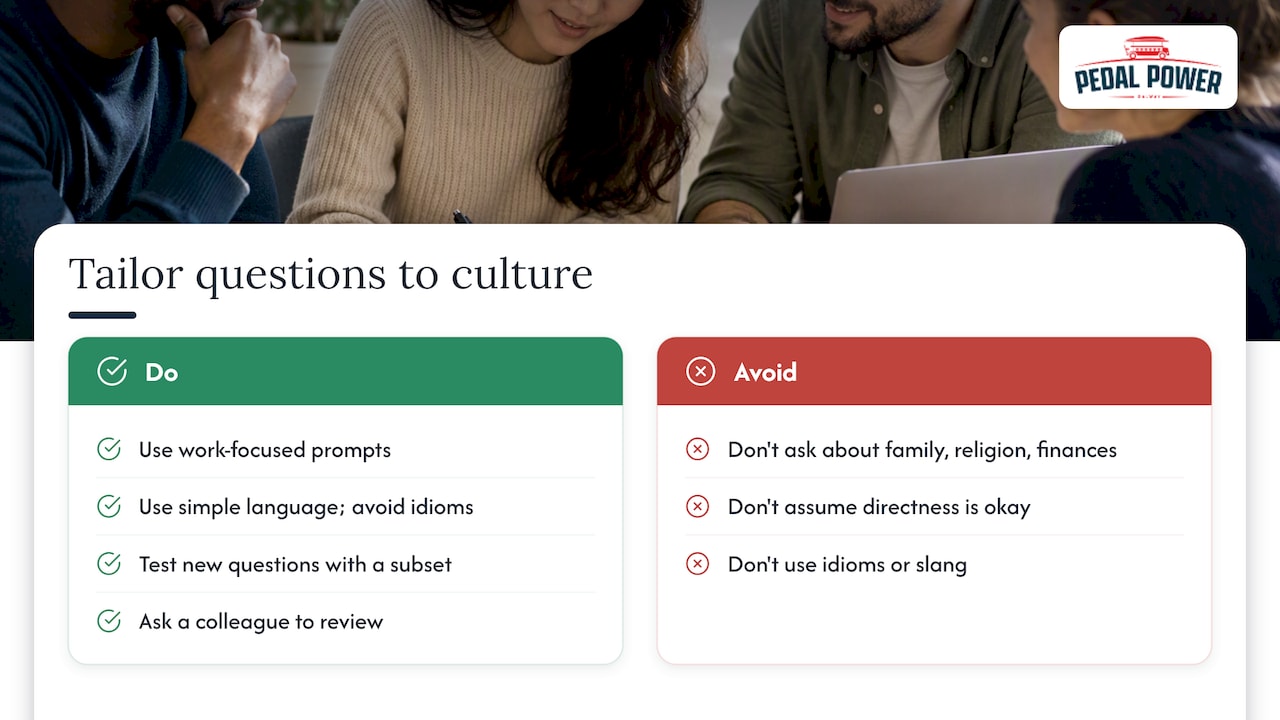
Some teams have strong norms around directness, where blunt questions about mistakes or frustrations feel normal, while others need more indirect framing to get the same honesty. Colleagues from different backgrounds may also have varying comfort levels with discussing family, religion, or personal finances, so defaulting to work-focused or preference-based questions is safer for mixed or newly assembled groups. Language fluency matters too: simpler sentence structures and avoiding idioms make a question easier to answer confidently for non-native speakers, without changing its meaning. When in doubt, test a new question type with a smaller, trusted subset of the team first, or ask a colleague from a different background to review a prompt before using it with the wider group. The goal is a question that works for the specific people in the room, not a universally perfect one.
Measuring whether team bonding actually works
The honest answer is that most teams never measure this, and that is a missed opportunity, not a lost cause.
A short pulse check, one or two questions asked anonymously every few weeks, is a lighter-weight way to track whether trust is actually building rather than relying on a facilitator’s gut feeling. Psychological safety survey guidance points to Edmondson’s original seven-item scale as a compact way to measure this more formally, and notes that shorter one or two item pulse checks can be run weekly without exhausting people. Beyond formal surveys, informal signals matter too: are more people volunteering answers without prompting, are silences during rounds getting shorter, is anyone starting side conversations that build on a previous session’s answer. None of that is exact, but tracked over a few months it tells you whether the questions are shifting how the team actually talks to each other, or just filling five minutes at the start of a meeting.
Use questions as a management tool, not a gimmick
The teams that get the most out of this treat questions as a regular habit, not a one-off exercise. Start with one light question a week, repeat it until it feels normal, then deepen it gradually. Leaders should go first, model brevity, and show the level of honesty they want back.
— Pedal
Sources
- Psychological safety in the changing workplace: Work in America 2024
- Psychological safety and the critical role of leadership development (McKinsey)
- Keyword quiz: an icebreaker method for interdisciplinary teams – Integration and Implementation Insights
- 10 Expert-Backed Team Building Questions for 2026 (TextLauren)
FAQ
What are some good bonding questions?
Good bonding questions start light (preferences, favorites) for new or large groups, then move to get-to-know-you and reflective prompts as trust builds. The strongest ones are short, optional to answer, and paired with a quick follow-up question to keep the exchange two-way.
What are some good questions about teamwork?
Strong teamwork questions ask about specific friction points, like what’s slowing the team down or which colleague’s work makes a person’s job easier, rather than vague prompts about “collaboration.” Framing the question with a clear purpose and a time limit helps turn answers into something a facilitator can actually act on, per practical team-building guidance.
What are some good team bonding ideas?
Beyond question rounds, structured activities like a keyword quiz, paired breakout conversations, or short in-person events such as a group bike tour or a Qube Challenge session combine movement or games with built-in conversation prompts. The best ideas match the group’s size and trust level rather than chasing novelty.
What are good would-you-rather questions for team bonding?
Light, low-stakes comparisons work best: unlimited vacation versus a four-day work week, giving up email versus meetings, or presenting versus writing a report. These stay fun and safe for any group size because nobody has to reveal anything personal to answer.
Ready to turn these prompts into an actual event? A Qube Challenge session with Pedal Power Galway gives you 60 to 90 minutes of structured team activity for €70 per person, built around movement, games, and the kind of stop-and-share moments this guide describes, or check available tours to find the right fit for your group’s size and budget.