

A Qube Challenge is a staged, timed team competition, think live game show tasks with practice rounds and limited “lives,” built to force fast problem-solving and expose how a team actually communicates under pressure. It works for corporate groups who want more than an icebreaker but less than a full-day retreat. Planning one comes down to picking the right format, briefing it correctly, and pairing it with the right venue and timeline, all covered below.
TL;DR:
- Most Qube Challenges are designed to last between 60 and 90 minutes, with shorter mini versions available for conference breaks or lighter engagement.
- The event’s success depends on a well-structured practice round, which prevents early eliminations and helps teams understand mechanics before competition begins.
- Challenge venues should include staging areas, screens, and accessible features, with a separate debrief facilitator to maximize learning outcomes.
- Providers should be questioned about scalability, customization, safety, and accommodations to ensure the activity fits specific team needs.
- Combining indoor Qube competitions with outdoor activities like pedal tours enhances team bonding and increases overall participant satisfaction.
Table of Contents
- What Does a Qube Challenge Team Building Event Actually Look Like?
- Why Does the Qube Challenge Help Teams Build Trust?
- How Do You Plan a Qube Challenge Event Timeline?
- How Do You Choose and Brief the Right Qube Challenge Provider?
- What Are the Best Qube Challenge Formats and Combos?
- What Do Event Planners Consistently Get Wrong About Team Challenges?
- Book the Qube Challenge V’s Pedal Power Package
- Key Reading on Team Building and the Qube Format
- Sources
- FAQ
What Does a Qube Challenge Team Building Event Actually Look Like?
Picture a game-show set: bright lighting, a scoreboard, and other event experience enhancements including a host running the room like a quiz-night emcee. That theatrical setup isn’t decoration. It raises emotional engagement and makes team behavior visible in a way that a quiet meeting room never does, which is exactly what makes the debrief afterward hit harder.
The format runs on a few core mechanics:
- Practice rounds let teams learn the rules and the tech without consequences.
- Pressure rounds are the real, scored competition, usually team versus team.
- Lives cap how many wrong answers or failed tasks a team can absorb before elimination.
- Tasks mix trivia, physical challenges, logic puzzles, and quick-fire decision-making, scaled to whatever the group needs.
Teams typically run in small to medium-sized groups, with multiple teams competing at once. A short example sequence: teams pick captains, run one practice round to learn the Qube interface, then move into three or four scored pressure rounds with a running scoreboard, ending in a final task that decides the winner.
Why Does the Qube Challenge Help Teams Build Trust?
The theatrics are fun, but the format earns its place in a corporate calendar because it mirrors what actual research on team-building says works. Short, structured problem-solving activities, even five-minute ones, strengthen communication, trust, and collaboration, particularly when time is tight and a full offsite isn’t realistic, according to Bryant University’s research on brief team exercises. The Qube format essentially stacks several of these micro-challenges back to back, with scoring that keeps everyone honest about how well they actually cooperated.
The pattern behind the format: Teams that face timed pressure and then get a structured debrief tend to internalize lessons faster than teams that just play a game and move on. The scoreboard creates urgency; the debrief turns that urgency into insight.
Asana’s team-building research backs the same idea from a different angle, noting that escape-room-style and problem-solving challenges build teamwork specifically because they force people to divide tasks, listen under stress, and correct course together, not alone.
What this format targets well:
- Communication breakdowns under deadline pressure.
- Trust gaps between newer team members and established ones.
- Decision-making bottlenecks (who speaks up, who defers, who freezes).
For accessibility, most Qube-style providers can adjust task difficulty, seating, and physical requirements. Ask your provider directly rather than assuming a standard format fits every participant.
How Do You Plan a Qube Challenge Event Timeline?
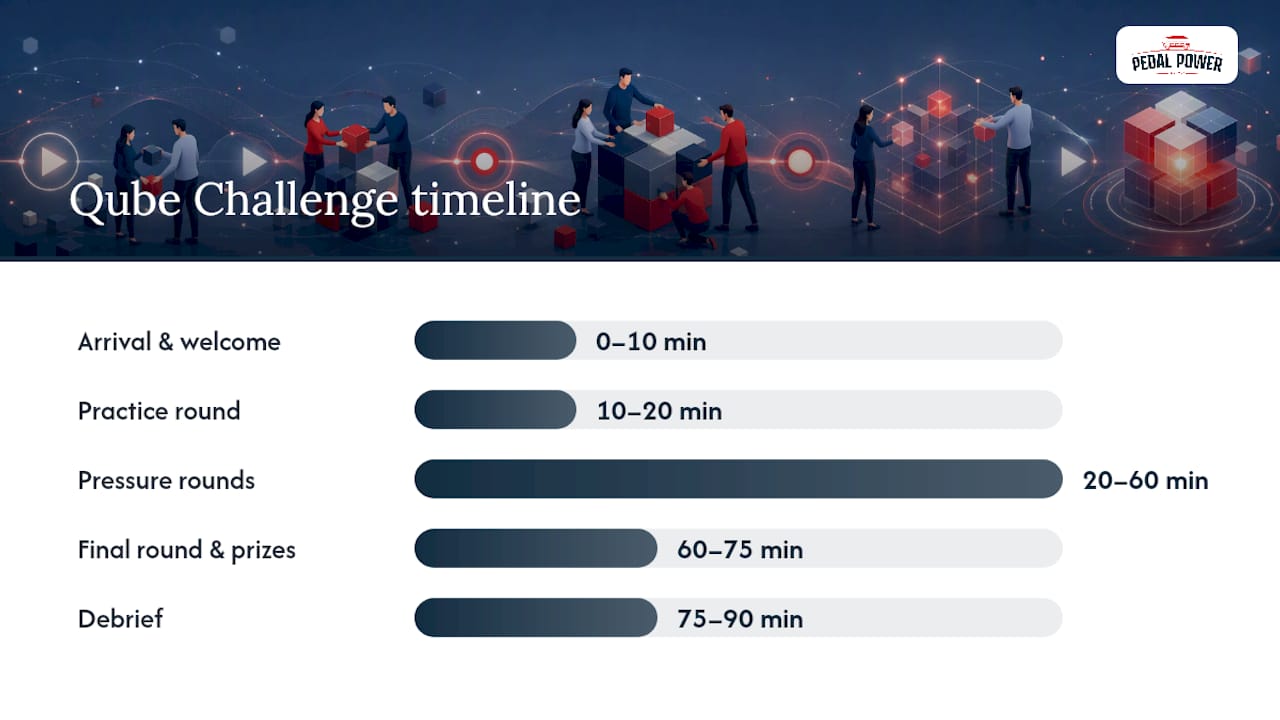
A Qube Challenge doesn’t need a full day. Most run comfortably within about an hour to an hour and a half, making it easy to slot into an existing offsite or half-day agenda.
Sample timeline:
- 0 to 10 minutes: Arrival, team assignment, quick welcome from the host.
- 10 to 20 minutes: Mandatory practice round so every team understands the mechanics before anything counts.
- 20 to 60 minutes: Pressure rounds, typically three or four, each scored and displayed live.
- 60 to 75 minutes: Final round and scoring, prize or award moment.
- 75 to 90 minutes: Facilitated debrief connecting what happened on the floor to how the team works day to day.
Venue and staffing checklist:
- Indoor space with room for staging, screens, and team clusters (an open hall or large conference room usually works).
- Sound system and enough visibility for every team to see the scoreboard.
- A host or game master running pace and rules.
- A separate debrief facilitator, don’t make the host do both jobs; the energy required for each is different.
- A scorer or timekeeper so the host isn’t also tracking points mid-round.
- Accessibility check: seating, mobility access, and any sensory considerations communicated to the venue in advance.
Pro Tip: Never skip the practice round to save time. The “lives” mechanic can eliminate a team early if they misunderstand the rules, and early elimination kills morale before the event even gets going. A short mandatory practice round fixes that almost entirely.
How Do You Choose and Brief the Right Qube Challenge Provider?
Not every Qube-style event is built the same, so the selection process matters as much as the event itself.
Decision factors to weigh first:
- Team size and whether the provider’s format scales to it.
- The specific objective, communication, decision-making under pressure, or cross-department trust.
- Available time window and whether a 30-minute or 90-minute format fits.
- Budget, since pricing varies by group size and customization level.
Questions worth asking any provider before you book:
- What’s the maximum and minimum group size you support?
- Can you show sample challenges or a run sheet in advance?
- How much can the format be customized to our industry or internal jokes?
- What insurance and safety documentation do you carry?
- What accommodations do you offer for mobility, hearing, or visual accessibility needs?
Briefing matters just as much as booking. Tell participants ahead of time that scoring is part of the fun, not a performance review, this single sentence in a pre-event email does more for psychological safety than almost anything else you can do. Leaders should be told to compete, not coach; nothing kills the format faster than a manager taking over their team’s strategy.
For measuring whether it worked, SessionLab’s team-building guidance recommends matching the activity to a specific goal and then checking against it afterward. A short post-event survey with three questions works well: Did you feel comfortable speaking up? Did the team make decisions faster than usual? Would you want to do this again? Watch, too, for observable signals in the weeks after: are the quieter team members speaking up more in regular meetings? That’s usually the real payoff.
What Are the Best Qube Challenge Formats and Combos?
The Qube format flexes more than people expect. A few variations worth knowing:
- 20 to 30 minute mini Qube: A single practice round plus one or two pressure rounds, good for breaking up a long meeting or conference day.
- 60 to 90 minute competitive event: The full format described above, with multiple pressure rounds and a proper debrief.
- Half-day combo: Pair the indoor Qube Challenge with an active outdoor block, like a group bike tour, so teams get both competitive problem-solving time and relaxed social bonding in the same booking.
- Virtual or hybrid adaptation: Remote teams can run breakout-room micro-challenges with a live scorer tallying results across locations, adapting the same lives-and-pressure-round logic to a screen-based format, an approach Asana’s research on remote team activities confirms works when properly adapted.
Combining an indoor competitive challenge with outdoor social time consistently raises how valuable participants rate the day, mostly because it gives a team both a task to solve together and unstructured time to just talk. If your group is deciding between the two, a broader HR-focused team-building guide can help map the objective before picking a format.
What Do Event Planners Consistently Get Wrong About Team Challenges?
Organizers come back to experiential formats like this one for a simple reason: a scoreboard and a timer produce honest behavior faster than any facilitated discussion ever will. You see who steps up, who goes quiet, and who starts problem-solving out loud within the first pressure round, information that would otherwise take months to surface naturally.
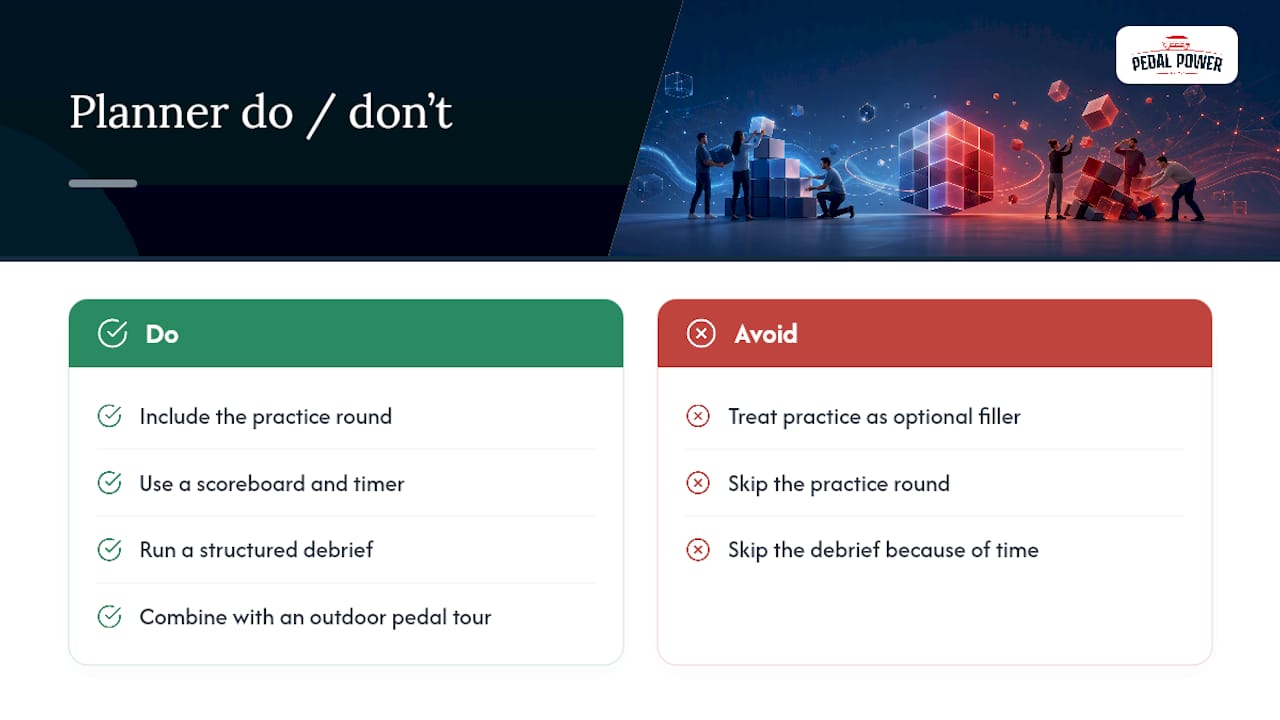
The most common mistake planners make is treating the practice round as optional filler. It isn’t. Skipping it means the “lives” mechanic eliminates teams before they’ve even learned the interface, which turns a bonding exercise into a source of resentment. The second mistake is skipping the debrief entirely because the schedule ran long. That’s backward; the debrief is where the behavioral patterns everyone just witnessed actually get named and connected back to how the team works Monday morning.
Combining the Qube Challenge with an outdoor pedal tour tends to produce the strongest feedback from groups, likely because the contrast between focused competition and relaxed group cycling gives people two very different ways to bond in a single afternoon.
— Pedal
Book the Qube Challenge V’s Pedal Power Package
Pedalpowergalway runs the Qube Challenge as a packaged combo, not a standalone rental, which means you skip the usual hassle of booking a venue, a facilitator, and a social activity separately.
The Qube Challenge V’s Pedal Power package pairs the staged, scored Qube competition with a guided pedal tour through Galway on large open-air party bikes, with pricing available on the website. It suits corporate groups who want a genuine problem-solving challenge in the morning or afternoon, followed by a relaxed, social outdoor block that lets the team actually decompress together.
Booking is straightforward: reach out through the product page with your preferred date, group size, and any accessibility notes so the practice round and seating can be adjusted in advance. Confirm insurance details and flag any custom requests, like themed scoring or industry-specific tasks, when you inquire. If your group also wants a lower-key social option on the same trip, the 1 3/4 hour pub crawl tour pairs well as a follow-up evening event. Reach out today to check dates for your team.
Key Reading on Team Building and the Qube Format
For more on the research behind short problem-solving activities, see Bryant University’s five-minute activity guide and Asana’s team-building resource. For the Qube format’s learning applications, see Project Champions.
Sources
- 30 Five-Minute Team-Building Activities | Bryant University
- 45 Team building games to bring teams together at work
- Qubed — BlueSky at Deene Park
- Project Champions — QUBE
FAQ
What Is a Qube Challenge in Team Building?
It’s a staged, timed team competition using game-show style tasks, practice rounds, and a limited-lives elimination mechanic to build fast problem-solving and communication under pressure.
How Long Does a Qube Challenge Event Take?
Most run 60 to 90 minutes for a full competitive event, though mini formats of 20 to 30 minutes work for meeting breaks.
How Much Does a Qube Challenge Cost With Pedalpowergalway?
The Qube Challenge V’s Pedal Power combo includes both the challenge and a guided pedal tour; current prices are available on the pricing page.
Can the Qube Challenge Be Adapted for Accessibility Needs?
Yes, providers can typically adjust seating, task difficulty, and physical requirements, but you should confirm specific accommodations directly when booking.
What Happens if a Team Loses All Its Lives Early?
Mandatory practice rounds are designed to prevent that; without one, early elimination from the lives mechanic can unfairly cut a team out before they understand the rules.