

Ireland has no single noise limit written specifically for party bikes. Three things apply instead: the general legal test for noise nuisance, a road traffic rule on loudspeakers on vehicles, and the house rules the operator sets. If you organize a group ride in Galway, the practical answer is to book a guided tour with a host who controls the music and the stops. Then the noise question is handled before anyone gets on the bike.
This guide explains each layer in plain terms, who deals with complaints and what happens next. It also covers what to ask an operator when you book a hen, stag, birthday or team event.
TL;DR
- No national decibel limit applies to party bikes. Noise is judged by the nuisance test in the Environmental Protection Agency Act 1992.
- A loudspeaker that can be heard outside a vehicle on a public road is restricted under the 1963 road traffic regulations, unless the local authority has issued a special permit.
- Complaints go to the local council or An Garda Síochána. A person can also take a Section 108 case to the District Court.
- Good planning (volume, route, timing and a host in charge) matters more than any single number.
- Our guided Galway tours are built around music, stops and games, so tell us what kind of atmosphere your group wants when you book.
Table of Contents
- Is there a legal noise limit for party bikes in Ireland?
- The nuisance test in plain words
- The loudspeaker rule on a public road
- What the operator controls
- Planning a ride that stays friendly
- Who handles a noise complaint, and what happens next
- A simple noise plan for organizers
- Why a guided tour beats organizing it yourself
- Our view on noise and a good ride
- FAQ
- Sources
Is there a legal noise limit for party bikes in Ireland?
No. Galway County Council’s Noise Action Plan 2024 to 2028 notes that Ireland has no national mandatory noise limits and no obligatory sector-specific limits. It names two exceptions: a 43 dB limit for small-scale energy production sources and by-laws on busking. Party bikes are not in either category.
That means nobody can hand you a decibel figure to stay under. The law works differently. It asks whether the noise is a nuisance, and that depends on context: how loud, how long, how often and at what time of day.
The same plan also records that there is currently no clear statutory guidance to help apply the nuisance provisions. In other words, the test is a judgement call, and a sensible organizer plans to stay well inside it.
The nuisance test in plain words
Galway City Council explains that under the Environmental Protection Agency Act 1992, noise is a nuisance when it is so loud, continuous, repeated, or of such duration or pitch, or occurring at such times, that it gives reasonable cause for annoyance. The test covers people in nearby premises and people lawfully using a public place.
For a party bike, four factors do the work:
| Factor | What it means on a ride |
|---|---|
| Loudness | Music that carries well beyond the bike into upper-floor flats and hotel rooms |
| Duration | A bike parked and playing music in one spot for a long stretch |
| Repetition | The same street passed again and again |
| Time of day | Late evening and night, when residents expect quiet |
A tour that keeps moving, plays music at a sociable level and follows a planned route is in a very different position from a stationary bike blasting music outside the same houses for an hour.
Galway County Council also sets out that, under the 1994 Noise Regulations and Section 107 of the 1992 Act, local authorities can serve a notice on industrial or commercial premises to prevent or limit noise. Section 107 is mostly aimed at sites regulated by the council or the EPA, which is why most noise complaints about a moving group end up as a conversation, a Garda matter or a Section 108 case, covered below.
The loudspeaker rule on a public road
This is the rule most organizers miss. Article 35(1) of the Road Traffic (Construction, Equipment and Use of Vehicles) Regulations 1963 says a vehicle must not be used on a public road while it carries a public address system with a loudspeaker or similar device capable of being heard outside the vehicle. The exceptions are limited: the Gardaí, ambulance and fire brigade, large public service vehicles addressing their passengers, and certain election-related uses.
The same regulations allow a person to apply to a local authority for a special permit authorizing the use of such a system on a public road in that authority’s area. So the question is not whether music on wheels is banned outright. It is whether the sound system is set up and, where needed, permitted in a way the rules allow.
What this means for you as an organizer:
- Do not bring your own speaker and attach it to a bike or trailer. The responsibility for how the vehicle is used does not sit well with a group member’s portable kit.
- Do not assume the vehicle’s built-in system is covered by an exemption. Ask the operator how the sound is arranged.
- If you plan a bigger event with several vehicles, such as a convoy, contact Galway City Council early about what the event needs.
Galway City Council’s Parking Control Bye-Laws 2025 add a narrower rule, as noted in the same research: making unnecessary noise by means of a loudspeaker or radio connected to a vehicle while parked in a ticket parking place is prohibited. So a parked bike with the music turned up is the worst combination on both counts.
What the operator controls
The law sets the outer boundary. Inside it, the operator’s own rules decide how a ride actually sounds. Look for answers to these questions when you book:
- Who controls the music, and can the volume change as the route changes?
- Are there quiet zones, for example near hospitals, churches, hotels and residential streets?
- How long does the bike stop at each point, and what happens during stops?
- Is there a host or driver with authority to turn the music down, or to stop the group singing?
- What is the plan for the last stretch, when groups are at their loudest?
Our party bike etiquette guide covers the rules the driver enforces on the day, and our music planning guide shows how to build a 30 to 40 minute playlist that suits the route. A playlist with a gentle opening and a build towards the middle of the ride is easier on the neighborhood than a wall of sound from the first minute.
Planning a ride that stays friendly
Most noise problems are predictable. Here is how to avoid them.
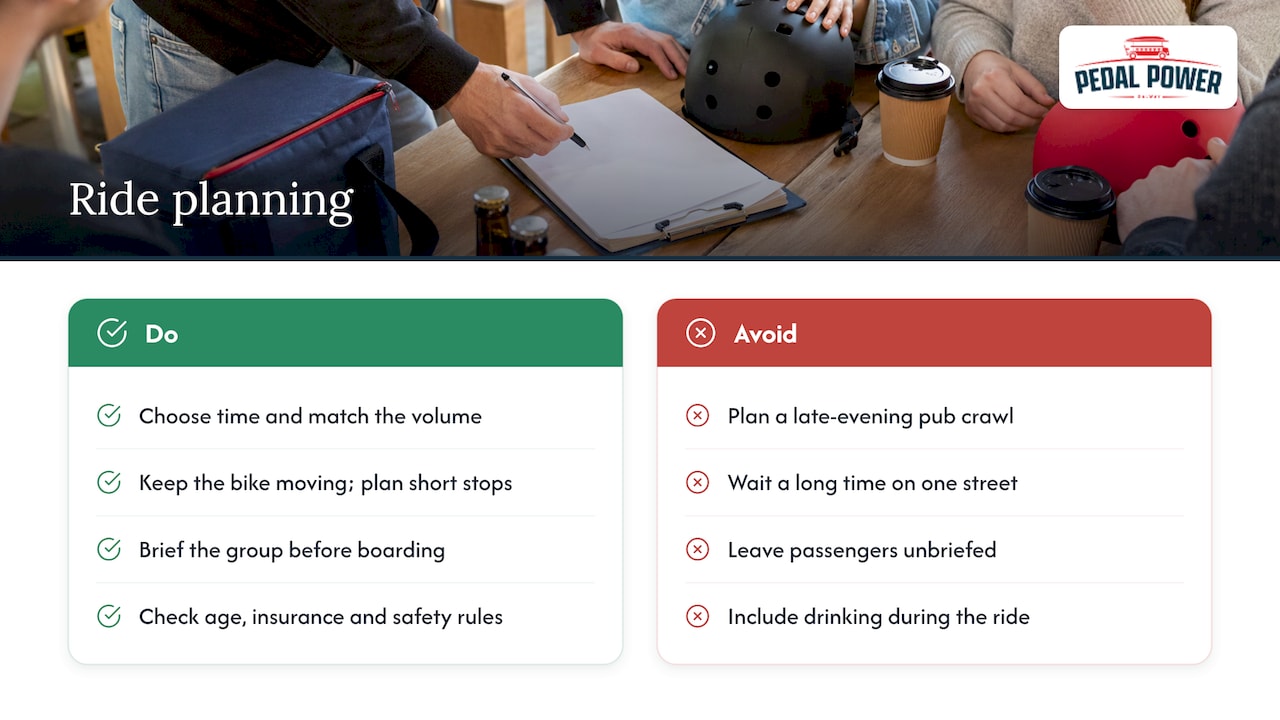
Choose the time of day with care. The nuisance test gives weight to when noise happens. A mid-afternoon sightseeing ride and a late-evening pub crawl are different propositions for residents. Decide which one fits your group, then plan the volume to match.
Keep the bike moving. Duration is part of the test. A route with planned stops that are short and purposeful draws far fewer complaints than a long wait on one street.
Brief your group. The loudest part of a party bike is often the passengers, not the speakers. Tell the group before boarding that singing is welcome on the move and that the host may ask for quiet in certain streets.
Respect the alcohol rule. Drinking is not part of the ride itself. Our guide to no alcohol while the bike is moving explains why this matters for safety, and a sober group is also a more controllable group on noise.
Check the wider rules. Noise sits alongside age limits, insurance and safety. Our overview of party bike laws in Ireland and the pre-ride checklist put these in one place.
Who handles a noise complaint, and what happens next
If someone objects to the noise, there are several routes, and most are informal.
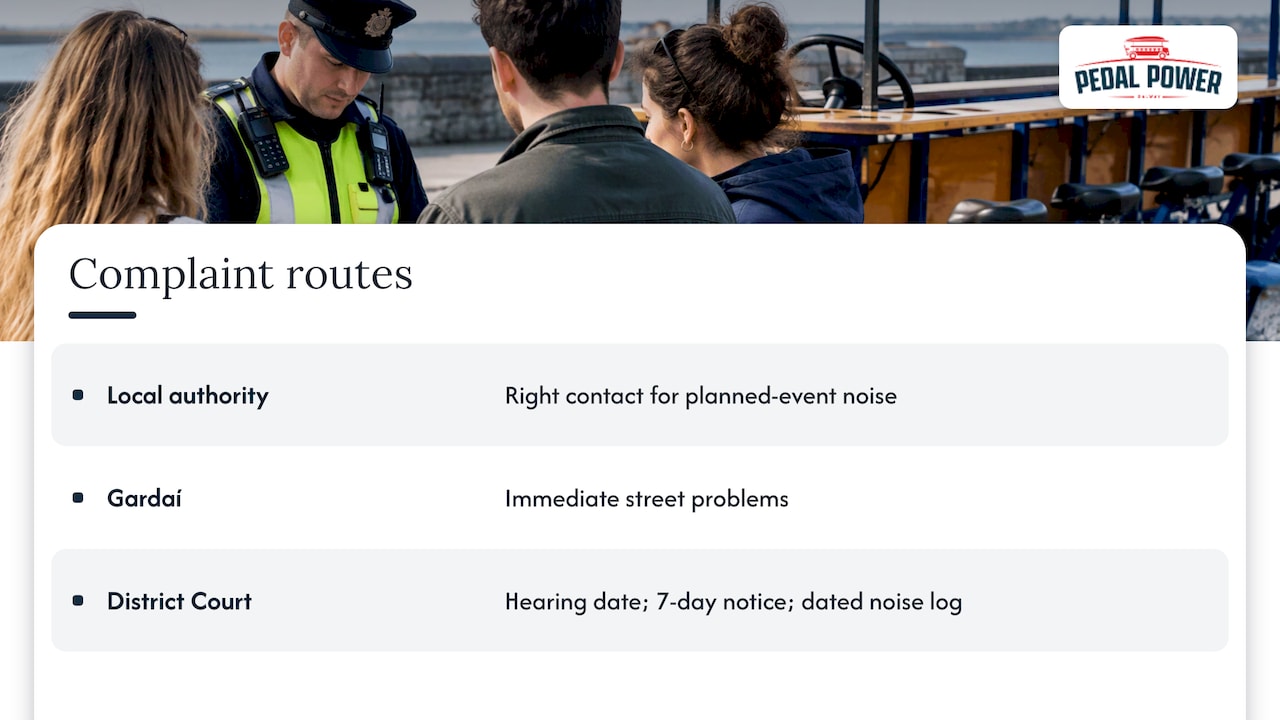
The council. Galway City Council says most noise nuisances can be resolved amicably. Galway County Council accepts noise complaints through an Environmental Complaints Form, and its environmental office is open Monday to Friday, 9:00 am to 4:00 pm. For planned events, the EPA’s guidance is that the local authority is the right body to contact about noise complaints.
An Garda Síochána. The city council notes that antisocial behavior, including loud music, may be reported to the Gardaí. This is the route for an immediate problem on the street.
The District Court. Under Section 108 of the 1992 Act, any person can complain to the District Court and ask for an order to reduce, prevent or limit noise. The city council does not take Section 108 cases on behalf of individuals. The EPA describes this as a straightforward way for individuals or groups to seek redress through the courts.
A complainant has to follow a process. Citizens Information says they must get a hearing date, refer to Section 108 and the 1994 Regulations, and tell the other party at least 7 days before the hearing. The Courts Service advises keeping a detailed log of the noise with dates, times and duration.
The EPA’s national protocol adds a point that is useful for any business: where noise is made in the course of a trade or business, it is a defence to show that all reasonable care was taken to prevent or limit the noise. Planning the route, volume and timing in advance is exactly that kind of care.
A simple noise plan for organizers
Before you book, write down answers to these. It takes ten minutes.
| Question | Why it matters |
|---|---|
| What time does the ride start and finish? | Time of day is part of the nuisance test |
| How many people are riding? | A full bike is louder than a half-full one, mostly from voices |
| What mood do you want: sightseeing, party or team event? | Sets the music level and the route |
| Are there guests who need a calmer ride? | Lets the host pick quieter streets |
| Who is the single point of contact in your group? | One person can pass on the host’s requests quickly |
Then share the plan with the operator. A host who knows the group wants a lively but neighbor-friendly ride can shape the route and the music around it.
Why a guided tour beats organizing it yourself
Noise rules touch the vehicle, the route, the timing and the behavior of the group all at once. Organizers who try to piece these together themselves end up solving problems on the street. A guided tour puts one person in charge of the experience, which is how you keep a big group fun and within the rules.
Our tours are designed around music, stops and games with a host, on open-air bikes that seat up to 44 people. For a group that wants a social evening, the 1 3/4 hour pub crawl tour is €50 per person, and the 3 hour pub crawl tour is €70. If your group would rather mix the ride with a challenge, the Pedal Power v’s Escape Room is €60 per person and the Qube Challenge v’s Pedal Power is €70 per person.
Tell us about your group and the atmosphere you want when you book your Galway tour, and we will shape the ride around it.

Our view on noise and a good ride
We run pedal-powered group tours in Galway, and we think the best party bike ride is one the whole street enjoys, not only the people on the bike.
Our tours are built around music, stops, games and lively hosts. That mix is the reason groups choose us over a standard bus tour. It also means the host is always there to read the mood: more energy on the open stretches, a lighter touch where people live.
When organizers ask us about noise, we point them to the same basics set out above. Plan the timing, keep the group moving, brief your guests before boarding, and let the host guide the volume. A group of up to 44 people can have a brilliant time on one bike when someone experienced is steering the experience.
If your event is bigger than a single bike, such as a convoy or a team social, talk to us early so the plan is clear before the day.
Pedal
FAQ
Can a party bike play music in Galway?
The 1963 road traffic regulations restrict a loudspeaker system capable of being heard outside a vehicle on a public road, unless an exception applies or the local authority has granted a special permit. Ask the operator how the sound is arranged on your tour. Do not add your own speaker to the bike.
Is there a time after which party bikes must be quiet?
No national curfew or decibel limit applies to party bikes. The nuisance test considers the time at which noise occurs, so later hours carry more risk of complaint. Keep late-evening rides moving and keep the volume sociable.
Who do I contact if a party bike is disturbing me?
For an ongoing problem, contact Galway City Council or Galway County Council, depending on where it is. For loud antisocial behavior happening now, you can report it to An Garda Síochána. As a last step you can bring a Section 108 complaint to the District Court.
Do I need a permit for a party bike event?
A permit is relevant if a sound system on a vehicle would be heard outside it on a public road, and it is applied for through the local authority. For a normal booked tour, speak to the operator first. For a larger or unusual event, contact Galway City Council early.
How can I keep my group from causing complaints?
Choose a sensible start time, keep the bike moving, brief your guests on singing and volume, and follow the host’s requests. Our safety guide lists the rider rules worth agreeing on before the day.
Sources
- Noise Nuisance, Galway City Council
- Noise, Galway County Council
- Noise Action Plan 2024 to 2028, Galway County Council
- S.I. No. 190/1963, Road Traffic (Construction, Equipment and Use of Vehicles) Regulations
- Environmental Noise FAQs, Environmental Protection Agency
- Noise pollution and noise complaints, Citizens Information
- How to make an excessive noise pollution application, Courts.ie
- National Protocol for Dealing with Noise Complaints for Local Authorities, EPA