

A party bike charity event is a group ride on a large pedal-powered bike, where the fun of the ride is used to raise money for a cause. Unlike a conventional charity cycle, nobody needs a road bike, fitness or a licence. A group of friends, a workplace or a club books a guided ride, and the fundraising comes from sponsorship, a per-person donation or a collection at the end. This guide covers how to plan one in Ireland, what permissions and insurance matter, and how to handle the money so your charity partner is happy.
TL;DR
- A party bike fundraiser is a social, guided group ride, so almost anyone can take part. The fundraising is a separate layer that you organize with your charity.
- Money raised in a public place needs a local Garda permit, and events involving the public need public liability insurance, according to the Road Safety Authority.
- Keep ride cost and donations apart. Riders pay the tour price, and donations go straight to the charity with a clear record.
- In Galway our tours seat up to 44 people on open-air bikes with music and a guide, and can be customized for your group.
- Agree the cause, the route, the start time and the donation method at least a few weeks before the ride.
Table of Contents
- What a party bike charity event is, and how it differs from a charity cycle
- Is a party bike the right format for your fundraiser?
- Step 1: Partner with a charity before you announce anything
- Step 2: Choose the format and the route
- Step 3: Permits, insurance and safety
- Step 4: Count the money honestly
- Step 5: Make the day work
- Our perspective
- Book a ride for your fundraiser
- FAQ
- Sources
What a party bike charity event is, and how it differs from a charity cycle
Traditional charity cycles in Ireland are endurance events. The Croí Corrib Charity Cycle in Galway, for example, offered 107 km and 47 km routes in its 2025 edition, with route support, mechanical assistance and a post-ride party. Riders train, wear cycling kit and fundraise individually. It is a fine format, but it asks a lot of participants.
A party bike event flips that. One large bike carries the whole group, everyone pedals together (or simply sits and sings along), and a trained host steers and guides. The distance is short, the pace is relaxed and the social side is the point. That makes it a good fit for people who would never sign up for a 100 km sportive:
- workplace teams raising money for a chosen charity
- hen and stag groups who want to turn a celebration into a donation drive
- birthday groups asking guests to give to a cause instead of buying gifts
- clubs, societies and community groups with a mixed age range
The trade-off is scale. A single bike seats a limited group, so the money comes from many small donations per rider and from the people who sponsor them, not from a mass-participation entry list. Plan with that in mind.
Is a party bike the right format for your fundraiser?
Choose it when your main aim is to get a group together, create a memorable day and give each person a reason to ask friends and family for sponsorship. A party bike works well when:
- Your group is 10 to 44 people and wants to stay together.
- Participants have mixed fitness levels.
- You want entertainment built in, such as music, themed stops and games.
- You want a defined, short, guided route in a city centre rather than a full day on rural roads.
It is a weaker fit if your charity needs a long-distance challenge to attract big sponsorship per rider. In that case a conventional sportive may serve better, and you could still add a party bike ride as a send-off or celebration afterwards.
Step 1: Partner with a charity before you announce anything
Fix the cause first. Ireland’s Charities Regulator guidance says charities should identify the cause and how donations will be used, keep proper books of account, and be able to give a full account of each fundraising event, including gross funds raised, costs and the charitable purpose receiving the proceeds.
In practice, that means:
- Contact the charity’s fundraising team. Ask whether they will support your event with a donation page, sponsorship forms, buckets, branding and a named contact. Many charities have a standard process for third-party events.
- Get written agreement on how the event may use their name and logo.
- Use the charity’s own donation page where possible, so money never passes through your personal account.
- Decide who pays the costs. If riders pay the tour price themselves and every donation goes to the charity, the accounting is simple and the charity can report gross funds raised with no event costs deducted.
The Regulator also expects fundraising to protect public trust, with trustees able to explain and justify their approach. Anything you say in your event invitation about where the money goes should match what the charity will say.
Step 2: Choose the format and the route
The organizers of conventional rides think about distance and pace. Schooldays.ie’s guide suggests 10 or 20 mile day-ride options and a group speed of roughly 7 to 10 miles an hour for around 30 people. A party bike tour is far shorter and slower, so the useful lessons are the planning habits: pick an accessible start and finish point near public transport, check the route and facilities in advance, and avoid awkward right-hand turns across traffic where you can.
For a Galway city ride, think about three things.
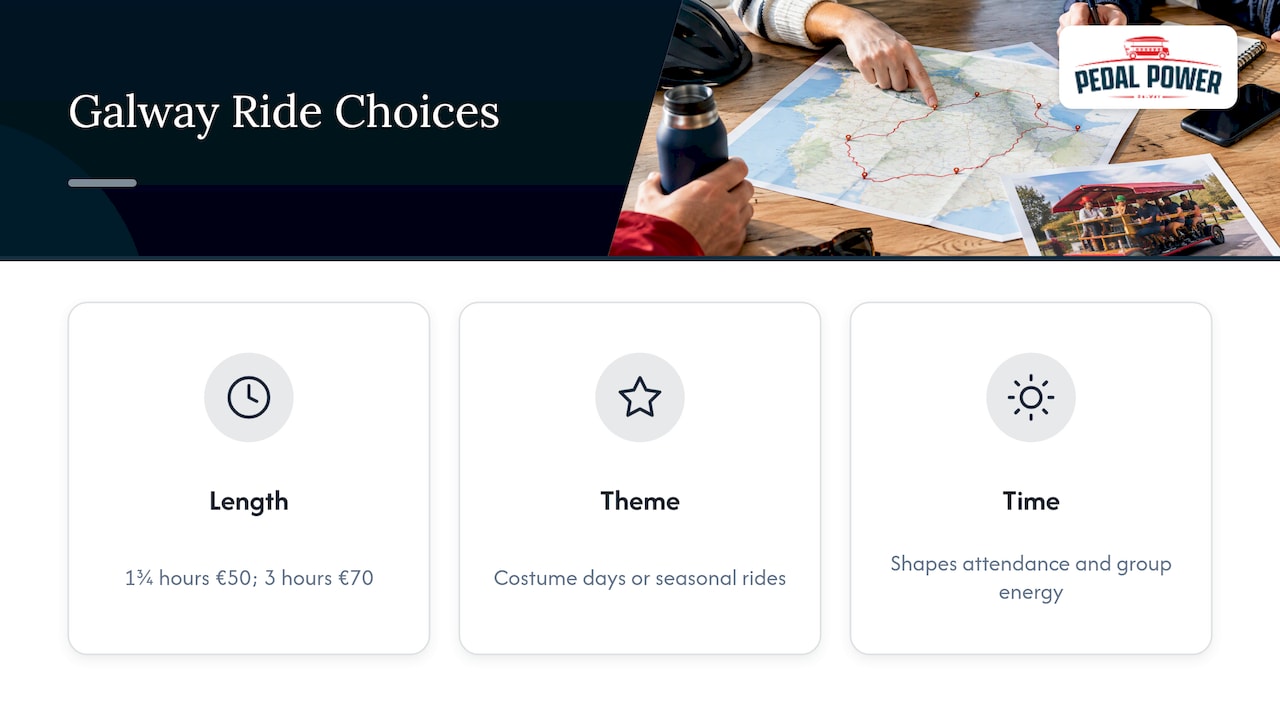
Length. Our guided options run for a fixed time rather than a fixed distance. The 1 3/4 hour pub crawl tour suits a lunchtime or early evening fundraiser, and the 3 hour version gives more room for stops and games. The 1 3/4 hour tour is published at €50 per person, and the 3 hour tour at €70.
Theme. A theme gives people something to post about, which helps donations. Our page on party bike themes has ideas that suit Irish groups, from costume days to seasonal rides.
Time of day. The start time shapes who comes and how much energy the group has. We cover that in party bike times in Galway.
Add an activity that raises more
A ride alone gives people one reason to donate. Pairing it with a challenge gives them another. We run packages that combine the bike with a second activity: Qube Challenge v Pedal Power at €70 per person, and Pedal Power v Escape Room at €60 per person. Teams can compete, and your charity can invite sponsors to back the winning team or pledge per puzzle solved. Our Qube Challenge review explains what to expect on the day.
Step 3: Permits, insurance and safety
This is the part organizers skip and then regret. The rules depend on where you are and what you are doing.
Collecting money in public
The RSA’s charitable events guidance says a public collection in a public place requires a permit from the local Garda. If you plan to shake buckets on Shop Street or outside a pub, talk to the Gardaí first. The easy alternative is an online donation page and a QR code on the bike, so nobody collects cash in the street at all.
Insurance and risk assessment
The same RSA guidance says events involving the public must have public liability insurance and that organizers should have a risk assessment approved by a health and safety professional. If you hire a tour operator, ask what cover they hold and what your own event adds. Our page on party bike safety lists the questions worth asking: insurance, a sober driver and the rules for riders.
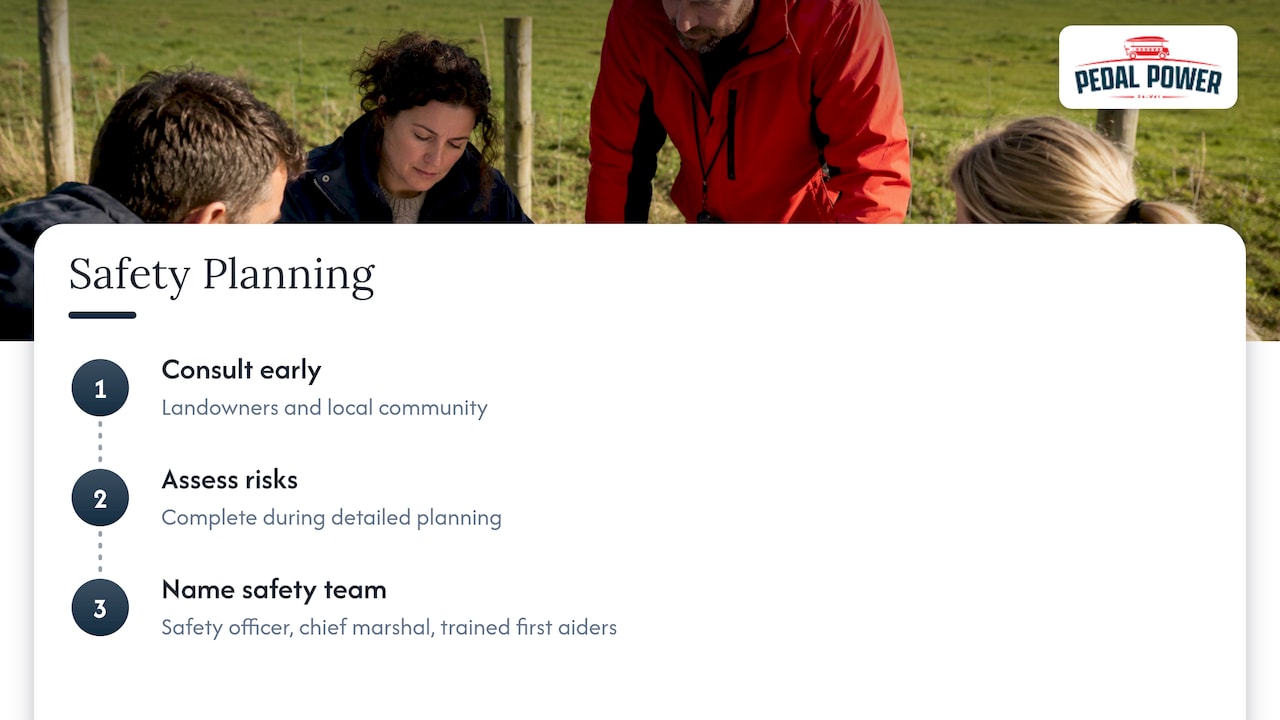
If you grow into a bigger event, Fáilte Ireland’s 2025 outdoor activity event guidelines call for early consultation with landowners and the local community, a full risk assessment in detailed planning, and a named safety officer, chief marshal and trained first aiders.
Road rules and alcohol
A party bike is a road vehicle in practice, so the rules on public roads matter. Our guide to party bike laws in Ireland sets out what organizers need to know. Two points matter most for a charity event. First, drinking while the bike is moving is not allowed, as explained in our page on no alcohol while moving. Second, the driver sets the rules of conduct on board, covered in party bike etiquette.
If your charity prefers an alcohol-free event, perhaps because the cause relates to health, youth or addiction, read our sober party bike ideas. It is easy to build a fundraiser around the ride without a pub stop.
Accessibility and practical needs
Cycling Ireland’s event organizer guidance lists what to look for in a venue: toilets, easy access for emergency vehicles, public transport nearby and parking, including disabled parking. Fáilte Ireland’s guidelines add that events meant to be fully or partly accessible should consult local and national disability groups. For a city ride, tell your group in advance about boarding, seating and toilet breaks. We have a page on bathroom stops in Galway for exactly this.
Do you need a Cycling Ireland permit?
Cycling Ireland requires events it governs, including club events, to receive a permit and submit a risk assessment at least 30 days beforehand, and events without a permit cannot use its event insurance. That framework is aimed at organized cycling events with entries, so a small party bike ride booked with an operator usually works differently. If you are unsure which category your plan falls into, ask Cycling Ireland and your insurer before you advertise.
If you are tempted by forest or park land
Coillte, which manages much of Ireland’s forest, publishes recreation permit terms. Its 2026 document says charity events on its land carry no permit fee only where 100% of funds raised go to a registered charity or recognized community fund, and the minimum insurance is €6.5m public liability. A city party bike ride avoids this entirely, which is one more reason to keep your fundraiser on an urban route.
Step 4: Count the money honestly
A clean structure builds trust. Here is a simple model for a group of 30 on a party bike.
| Item | Who pays | Where it goes |
|---|---|---|
| Tour price (€50 per person on our 1 3/4 hour tour, so €1,500 for 30) | Each rider | The tour operator |
| Sponsorship and donations | Friends, family, colleagues | Charity’s donation page |
| Optional on-the-day donation | Riders and supporters | Charity’s QR code or approved bucket |
The tour price is the cost of the experience. It does not become charity money unless the charity or you have agreed something else with the operator in writing, so do not advertise it as a donation. A rider who raises €100 in sponsorship on top of paying for their seat has given the charity a clear €100.
To set a realistic target, multiply your rider count by a modest sponsorship goal. Thirty riders with a €75 goal each would aim at €2,250. That is a planning figure, not a promise. Ask each rider to share their own page and set a minimum, much as the Croí Corrib ride sets a €50 fundraising threshold for a jersey and a prize draw.
For comparison, other Irish rides use structures like this. Cycle Against Suicide’s Mizen to Malin 2026 charged €2,000 with hotel accommodation or €900 without, with a deposit and the rest raised through an automatic fundraising link. Our scale is smaller, but the principle is the same: a fixed participation cost, then fundraising on top.
After the event, publish the numbers. The charity needs gross funds raised, costs and what the money supports, and your supporters will want to see it too. If you plan to repeat the event next year, a clear thank-you post with the total is your best advertisement.
Step 5: Make the day work
A few practical choices turn a fundraiser into something people talk about for months.
- Brief the group. Send the start time, meeting point, dress code and charity details a week ahead. Confirm the charity’s donation link in the same message.
- Keep the music loud enough to enjoy, not to fight over. If you add a speaker or DJ at the finish, plan the power supply early. This guide to power needs for DJ events explains how to calculate it.
- Assign one person as co-ordinator. The RSA recommends an overall event co-ordinator and enough stewards with road safety and health and safety knowledge for events on the road.
- Add games and a prize. Best costume, loudest team or most raised per rider all work. Ideas for group warm-ups are in our icebreakers guide.
- Photograph everything and post it with the donation link while the mood is high.
Workplaces can also fold the ride into a wider plan. Our guides to team building activities in Ireland and outdoor team building show how a ride fits a company day. Hen and stag groups might start from our stag party route and add a donation page to the invitation.
Our perspective
We have watched hundreds of groups climb aboard a big open-air bike in Galway, and the pattern is always the same: within five minutes strangers are singing together. That energy is what a charity event needs.
A fundraiser succeeds when people enjoy giving their time, not just their money. A seat for up to 44 people, music, a lively host and a guided route in the city mean your supporters can all do it together, whatever their fitness. Nobody is left at the back of the pack.
Our advice is to keep the fundraising simple and let the ride do the work. Agree the cause with your charity, put the donation link on every message, and choose a tour length that matches your group. We can customize a tour, add a Qube Challenge or escape room contest, and help you pick a start time that suits your guests.
Pedal
Book a ride for your fundraiser
If you already know your group size and charity, the quickest step is to pick a tour. The 1 3/4 hour pub crawl tour is published at €50 per person, the Pedal Power v Escape Room package at €60 per person, and the Qube Challenge package at €70 per person. A teenager birthday tour is listed at €10. Tell us your charity, your group size and your preferred theme, and we will help you shape the ride.
Prefer to see everything first? Our home page shows the bikes and tours, and our party bike prices page explains costs in more detail.
FAQ
Can we collect cash on the street during the ride?
Only with the right permission. The RSA says a public collection in a public place needs a permit from the local Garda. The simpler route is an online donation page with a QR code, which also gives the charity a clear record.
Does the tour price count as a donation?
No, not unless you have agreed otherwise with the operator and the charity in writing. Treat the tour price as the cost of the experience and ask for donations separately, through the charity’s own page.
How many people can join one party bike?
Our bikes seat up to 44 people. For a bigger fundraiser, ask us about running more than one ride, and see our party bike convoy page for group bookings.
Does a party bike charity event need insurance?
Events involving the public must have public liability insurance, according to the RSA. Ask your operator what cover it holds, and check with your charity and insurer whether your event needs anything extra.
Sources
- Road Safety Information for Charitable Events, RSA
- Guidelines for Charitable Organisations on Fundraising, Charities Regulator
- Guidelines for Organising Outdoor Activity Events, Fáilte Ireland
- How to organise an event, Cycling Ireland
- Event Application, Cycling Ireland
- Recreation Permits and Licences, Coillte
- Tips for Organising a Sponsored Cycle, Schooldays.ie
- 31st Croí Corrib Charity Cycle Returns, Galway Daily
- Mizen to Malin Cycle of Hope 2026, Cycle Against Suicide
- Strombedarf DJ Veranstaltung