

Yes, party bikes can work for mixed-ability groups, and the answer usually comes down to three things: electric assist to cut down on pedaling effort, non-pedaling bench seats with real seatbacks, and an operator willing to talk through boarding and transfer needs before the ride. If an operator can confirm those three, most guests with mobility limits, stamina concerns, or balance issues can join. If they can’t, ask about alternatives before you book.
TL;DR:
- Most standard party bikes include non-pedaling bench seats, adjustable height options, and seatback features that improve accessibility for riders with mobility or balance concerns.
- True roll-on wheelchair access is rare on standard party bikes, but specialized vehicles like trishaws or electric trikes can accommodate wheelchair users with prior request; planning ahead is essential.
- Electric assist systems significantly enhance inclusion by reducing pedaling effort for all riders and should be confirmed as rider-activated rather than always-on at booking.
- Pre-booking requires detailed communication about mobility aids, seating preferences, and boarding assistance to ensure proper equipment and staffing are arranged in advance.
- Operator training varies and should include staff competence in transfer aid, sensory communication, and emergency response, with specific questions necessary to ensure proper inclusion.
Table of Contents
- What Party Bike Accessibility Actually Means
- Can a Wheelchair User Join a Party Bike Tour?
- Electric Assist and Pilot Controls: The Features That Do the Most Work
- The Booking Checklist Every Organizer Should Send
- Safety Supervision and Group Practices That Make the Ride Work
- When a Party Bike Isn’t the Right Fit
- What Pedal Power Galway Asks Before You Ride
- Adapting Party Bike Tours for Visual and Hearing Impairments
- Where to Find Accessible Party Bikes and Specialist Equipment
- What Accessible Party Bike Rentals Actually Cost
- Do Operators Need Special Training to Handle Accessible Bookings?
- Why the “Just Ask If It’s Accessible” Advice Falls Short
- Book an Accessible Party Bike Tour With Pedal Power Galway
- Sources
- FAQ
What Party Bike Accessibility Actually Means
Party bike accessibility isn’t one fixed standard. It’s a checklist of features and operator practices that determine whether a specific rider, on a specific bike, on a specific day, can get on and enjoy the ride safely. Most standard party bikes seat 15 to 40 people around a central bar or table, with a mix of pedaling positions and non-pedaling bench seats. That mixed layout is actually the built-in accessibility feature most people overlook: party bikes typically offer a combination of pedaling seats and non-pedaling bench seats, so a guest who can’t pedal isn’t automatically excluded from the ride itself.
Here’s what tends to separate an accessible setup from one that isn’t:
- Non-pedaling bench seats that let riders sit, socialize, and travel without contributing power.
- Adjustable seat height for shorter or taller riders and those with limited hip or knee flexibility.
- Seatbacks and grab rails, which matter enormously for anyone with balance concerns or a fear of tipping on turns.
- Seat belts or harnesses, offered by some operators for guests who need extra security.
- Platform stability and canopy coverage, which affects comfort for riders sensitive to sun, wind, or vibration.
Fleet-level adaptations like adjustable seats and seatbacks are relatively cheap to add and disproportionately expand who can ride, particularly older adults and anyone with mild balance issues. Most operators list these details on individual bike or fleet pages rather than a single “accessibility” tab, so it’s worth reading each bike’s specs rather than assuming a blanket policy.
Can a Wheelchair User Join a Party Bike Tour?
This is the question organizers get wrong most often, and it deserves a straight answer: usually not without extra planning. Standard party bikes sit riders up on a raised deck, which means a step-up of several inches to over a foot, depending on the model. That single detail rules out roll-on boarding for most standard fleets.
- Understand the default. Most standard party bike frames require a step-up, and true roll-on wheelchair access is rare outside specialized designs.
- Ask about specialist equipment. Some Irish operators run trishaws, VeloPlus wheelchair-transport bikes, and electric trikes that let a passenger roll on and lock in place without a manual transfer. These aren’t standard party bike stock, so they need to be requested specifically.
- Ask the right three questions. “Can my guest roll on, or will they need to transfer to a fixed seat?” “Do you provide ramps or transfer assistance, or should we bring our own helper?” “Is extra staff available for boarding, and does that come with extra lead time or a fee?”
Plateau-style cycles that genuinely allow roll-on boarding also need trained pilots and extra loading time, which is exactly why they’re rarely part of a standard party bike fleet and usually booked as a separate arrangement.
Electric Assist and Pilot Controls: The Features That Do the Most Work
Electric assist is arguably the single biggest lever for inclusion on a group bike. It doesn’t just make pedaling easier for one tired rider. It evens out effort across an entire mixed-ability group, so nobody feels like they’re the reason the bike is slowing down.
- Motor-assisted pedaling reduces the physical demand on any individual seat, which matters for riders with limited stamina, older guests, or anyone managing a chronic condition.
- Pilot-operated steering and braking mean the group itself isn’t responsible for balance or emergency stops, which is a real relief for riders with limited coordination or anxiety about group cycling.
- Adaptive attachments like trikes, tandems, or tag-alongs exist for some fleets and can be requested for a guest who needs a stabilized second seat rather than a shared bench position.
Operators that build electric assist and pilot-operated steering into their group bikes consistently report broader participation across age and ability ranges, since the physical bar for joining drops substantially.
Pro Tip: Ask specifically whether the electric assist is “always on” or rider-activated. Some systems only kick in once the group is already pedaling, which doesn’t help a rider who can’t generate that initial push.
The Booking Checklist Every Organizer Should Send
Copy this into your first email or booking form. A specific, upfront request gets a faster and more accurate answer than a vague “is this accessible?”
- Meeting point and surface: Is the pickup spot flat, paved, and step-free?
- Minimum pedalers and group size: How many riders actually need to pedal for the bike to move?
- Seating map: Can you assign specific seats in advance, including bench seats near the entry point?
- Electric assist confirmation: Is it standard on this bike, and how is it activated?
- Boarding equipment: Ramps, transfer assistance, or extra staff for loading?
- Service animal policy: Are service animals permitted, and does the operator need advance notice?
- Storage for mobility aids: Where do folded walkers, canes, or collapsible wheelchairs go during the ride?
- Staffing and safety: Is a pilot or driver present at all times, is staff first-aid trained, and what’s the emergency procedure if a rider needs to stop?
Accessible cycling providers routinely recommend pre-booking and a direct conversation so equipment can be matched to the actual guest rather than a generic assumption. Build in extra lead time. Specialist equipment and staff often need advance notice measured in days, not hours.
Safety Supervision and Group Practices That Make the Ride Work
Most reputable operators run the same core safety setup: a dedicated pilot or driver who steers and brakes, emergency braking systems, lights or reflective elements for visibility, a rider briefing before departure, and seatbacks or restraints on the seats that offer them. None of that is unique to accessible bookings. It’s standard practice that happens to benefit every rider with balance or mobility concerns.
What organizers control is the group side of the equation. Assign seats in advance rather than letting people scramble for spots, and put your most vulnerable riders in the seats closest to staff. Designate one or two helpers whose only job is assisting a specific guest on and off the bike. If alcohol is part of the tour, keep an eye on riders for whom drinking plus balance concerns is a real combination, and ask your operator whether they build in rest stops. A short pause every 20 to 30 minutes often matters more than people expect.
When a Party Bike Isn’t the Right Fit
Sometimes the honest answer is that a standard party bike is the wrong tool, and a good operator will tell you that rather than force a fit.
- Choose a trishaw or wheelchair-transport bike when a guest needs true roll-on access rather than a seat transfer.
- Pair the party bike with a support van so a guest who can’t manage the full route still travels with the group and joins at stops.
- Book a shorter circuit if stamina, not mobility, is the limiting factor. A 30 minute loop covers the social experience without the physical strain of a longer route.
- Include non-riding guests through planned stops, photo breaks, or a seat-paired helper arrangement so nobody spends the tour just watching from the sidewalk.
Combining a party bike with a party bus alternative for part of the group is often the simplest fix, and it costs organizers nothing but a bit of coordination.
What Pedal Power Galway Asks Before You Ride
Pedal Power Galway asks specific questions at booking rather than a generic accessibility box to tick: seating needs, mobility aids in the group, and whether any guest is bringing a service animal. That information shapes the actual setup, from which seats get assigned to how boarding is staged before departure.
On the operational side, building in an arrival buffer avoids rushed transfers, and a pre-planned seating map means helpers and staff aren’t improvising once the group shows up. Rides typically run 30 to 40 minutes, which is short enough that a tailored playlist and steady pacing matter more than raw endurance. Ask about seating maps and mobility aid storage directly when you book a tour.
Adapting Party Bike Tours for Visual and Hearing Impairments
Visual and hearing impairments get far less attention in accessibility conversations than mobility issues, but they change what a good ride looks like just as much.
For riders with visual impairments, the biggest factors are verbal orientation and physical guidance during boarding. A staff member walking a guest to their seat, describing the layout, hand position, and grab rail location out loud, does more than any equipment change. Ask whether staff are willing to do a slower, narrated boarding process rather than the standard quick load. Bright, high-contrast markings on steps or grab rails help too, though not every operator has them, so it’s worth asking directly.
For riders with hearing impairments, the challenge is usually the group briefing and any in-ride safety instructions. A pilot who gives a verbal-only safety briefing before departure can leave a guest who is deaf or hard of hearing without critical information. Ask whether the operator can provide a written summary of key safety points, or whether a companion or interpreter can relay instructions in real time. Visual cues, like a raised hand signal before stops or turns, are a low-cost fix that some pilots already use for noisy street environments and that double as a hearing-accessibility feature without anyone having to ask for something special.
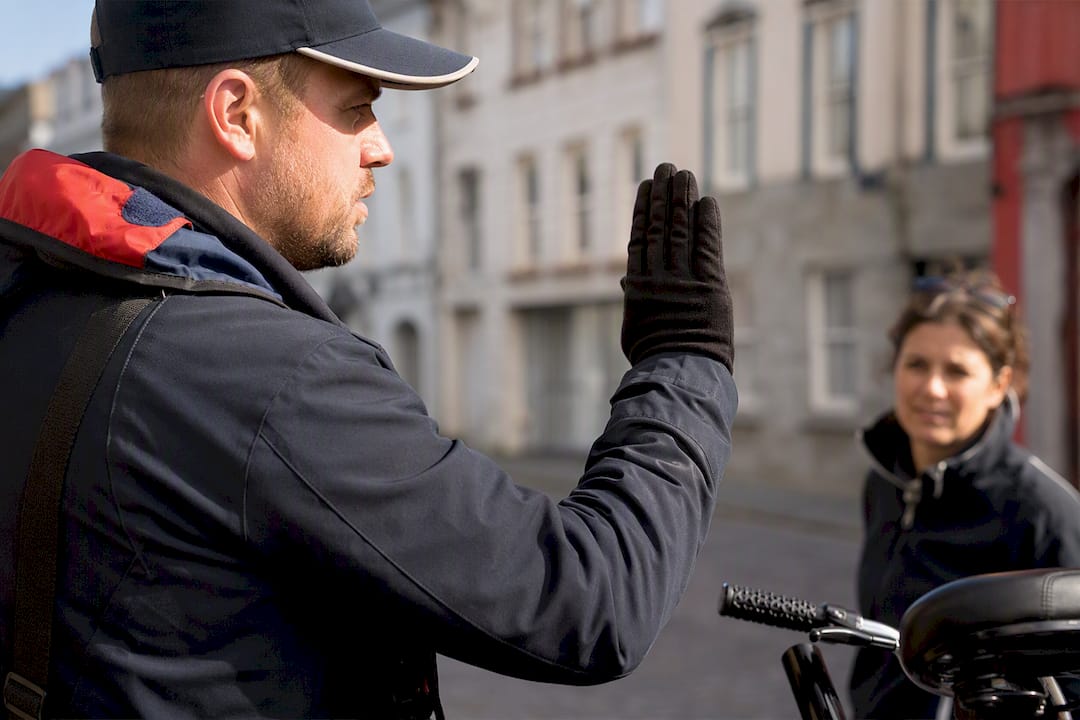
Neither adaptation requires special equipment. Both come down to whether staff are willing to slow down and communicate differently, which is exactly why asking about staff practices, not just hardware, belongs on every organizer’s list.
Where to Find Accessible Party Bikes and Specialist Equipment
Availability varies sharply depending on where you’re booking and what “accessible” actually needs to mean for your group. A standard party bike with bench seats and electric assist is common across most fleets and requires no special sourcing. True roll-on wheelchair equipment is a different story entirely.
Specialist gear like trishaws, VeloPlus wheelchair-transport cycles, and electric trikes tends to be concentrated with a smaller number of dedicated accessible cycling providers rather than general party bike operators. Accessible cycling providers that stock this equipment usually operate it as a distinct service line, separate from group party bikes, because the pilot training and loading process differ so much.
That split matters for planning. If your group needs both a social party bike experience and true wheelchair-accessible transport for one or two guests, you may be booking two different providers or coordinating a combined package rather than expecting one bike to do everything. Regional availability also shifts. Some areas have several operators running standard accessible-friendly bikes but no specialist wheelchair-transport option nearby, while others have the reverse. The only reliable way to know what’s actually available in your area is to ask each operator directly what equipment they own versus what they’d need to source from a partner.
Booking further ahead pays off here. Specialist equipment is often shared across multiple bookings or partner organizations, so last-minute requests are the ones most likely to come back empty.
What Accessible Party Bike Rentals Actually Cost
Pricing for party bike tours generally runs on group size and duration rather than a flat per-person accessibility surcharge, though that can shift once specialist equipment enters the picture. A standard party bike booking with electric assist and adjustable seating typically costs the same as any other group booking on that fleet, since those features are usually built into the bike rather than added on request.
Costs tend to rise when a booking needs something outside the standard fleet: a dedicated trishaw or wheelchair-transport cycle, an extra staff member for boarding assistance, or a longer setup window that eats into staff time elsewhere in the day. None of that is universal. Some operators absorb the cost of extra assistance as standard service, while others charge for specialist equipment separately because it comes from a different rental line entirely.
The practical move is to ask for a specific quote once you’ve described the accessibility needs, rather than assuming a standard group rate applies. Bring your numbers early: how many riders, how many need specialist seating or equipment, and how much lead time the operator needs to arrange it. That’s also the point where you’ll find out if a shorter route or a smaller group size brings the price down, since duration and headcount usually drive cost more than accessibility features themselves.
Do Operators Need Special Training to Handle Accessible Bookings?
There’s no single national certification that governs party bike accessibility, which means training standards vary a lot by operator. What’s consistent across reputable fleets is basic staff competency: pilots trained on the specific bike’s steering and braking, and at least one staff member with first-aid training on group rides.
Beyond that baseline, accessibility-specific training is largely operator-driven rather than mandated. Some providers train staff specifically on transfer assistance, service animal handling, and communicating with riders who have sensory impairments. Others rely on general customer service training and figure out accommodations case by case as requests come in. Neither approach is inherently wrong, but it means the quality of an accessible booking depends heavily on which operator you choose and how much they’ve actually invested in staff preparation beyond the legal minimum.
This is exactly why asking direct questions before booking matters more than trusting a marketing page. Ask whether staff have handled a mixed-ability group before, whether they’ve been trained on your specific equipment need, and how they’d handle a rider who needs help mid-ride. An operator who answers those questions specifically, rather than with a general reassurance, is the one more likely to deliver a smooth experience on the day.
Why the “Just Ask If It’s Accessible” Advice Falls Short
Most accessibility advice for group activities boils down to “call ahead and ask.” That’s true but incomplete, and it puts all the work on the organizer to guess what to ask. The research behind this guide points to something more useful: accessibility on a party bike isn’t binary. It’s a stack of independent features, electric assist, seatback design, boarding method, staffing, that each solve a different barrier. A bike can nail three of those and fail on the fourth, and generic reassurance from an operator won’t tell you which one.
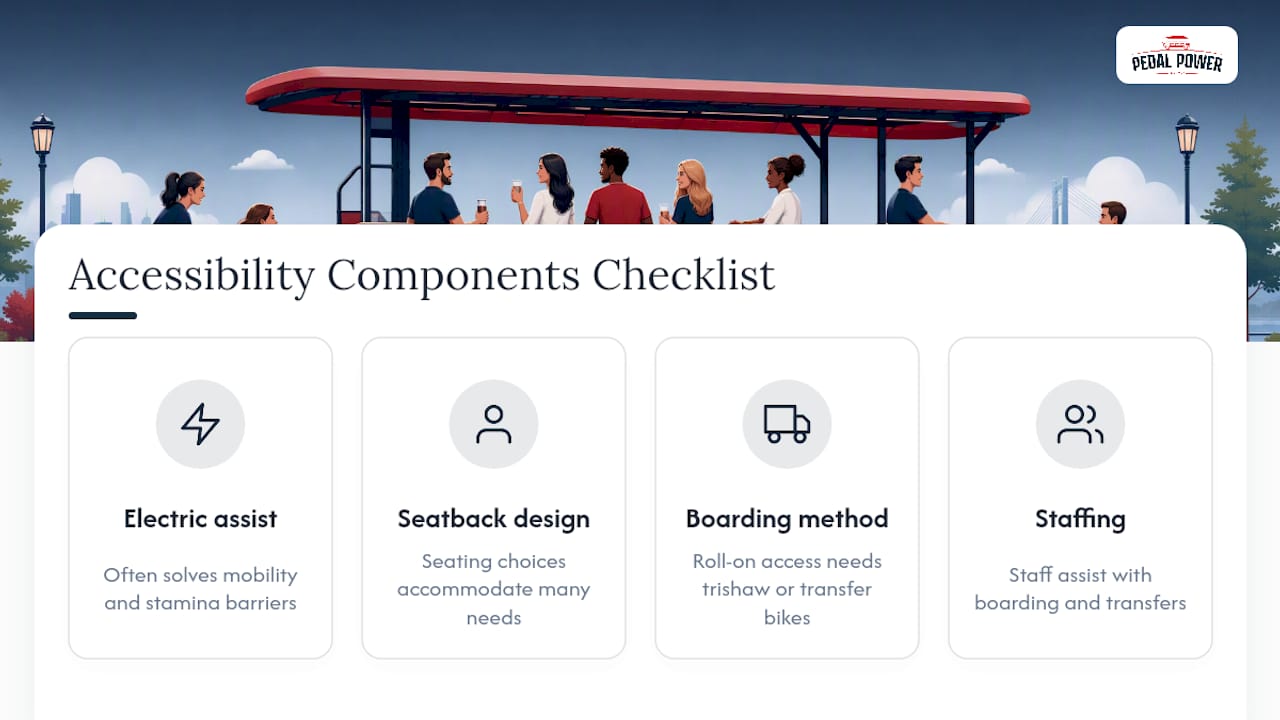
The overrated piece of conventional wisdom is that “accessible” fleets are a fixed category you either find or don’t. In practice, most standard party bikes can accommodate a wide range of mobility and stamina needs through seating choices and electric assist alone, without ever touching specialist equipment. What actually needs the specialist gear, true roll-on wheelchair access, is a smaller and more specific need than most organizers assume going in.
Prioritize the electric assist and seating conversation first. Only escalate to asking about trishaws or transfer bikes if your group genuinely needs roll-on access. That order saves time and usually gets you a workable answer faster.
— Pedal
Book an Accessible Party Bike Tour With Pedal Power Galway
Group tours built around bench seating and electric assist as standard can make it easier for mixed-ability groups to ride together.
If your group includes riders with mobility limits, stamina concerns, or a request for service animal accommodation, the fastest path is a direct conversation before you book. Tell us the group size, any mobility aids in the group, and whether anyone needs a specific seat near the boarding point, and we’ll confirm electric assist availability and staff support for your date. Organizers planning a hen party, birthday, or corporate outing can also look at custom group activities in Galway for ways to pair a party bike ride with a second activity that suits guests who need a lower-intensity option. Ready to lock in a date? Check availability and browse tours to start the conversation.
Sources
- Party bike — Wikipedia
- Disability Bikes | Locomotion Bike Rental
- Accessible Cycling | Dick’s Bike Hire
- Cork Bike Hire — Group bike hire
FAQ
How Does a Party Bike Actually Work?
A group of riders sits around a central bar or table on a wheeled platform, with some seats connected to pedals that help power the bike while a pilot handles steering and braking from a fixed position.
What Kind of Bikes Are Available for Riders With Disabilities?
Beyond standard party bikes with non-pedaling bench seats, specialist options include trishaws, VeloPlus wheelchair-transport cycles, and electric trikes that allow roll-on or seated transfer without a manual lift.
Can I Bring a Service Animal on a Party Bike Tour?
Most operators allow service animals but ask that you declare them in advance, since space and safety setups vary by bike and route.
Do I Need to Request Electric Assist in Advance?
It’s worth confirming at booking rather than assuming, since electric assist is common but not universal, and knowing how it activates helps you plan seating for riders with lower stamina.