

A party bike is a multi-passenger, human-powered vehicle where the riders themselves supply the pedaling force that moves it down the road. A trained Captain sits at a separate station, handling steering and braking, and usually does not pedal at all. Many modern units also carry a pedal-assist motor that only kicks in when passengers are actively turning the pedals.
Here’s the core breakdown:
- Propulsion: Passengers pedal from bench seats arranged around a central frame or bar.
- Control: A dedicated driver, often called the Captain, steers and brakes from a separate command position.
- Assistance: Some models add an electric motor that engages only while riders pedal, easing the load on hills.
Key Takeaways
A party bike moves because passengers pedal in sync through a shared drivetrain while a trained Captain, who does not pedal, handles all steering and braking.
| Point | Details |
|---|---|
| Propulsion source | Passengers pedal from bench seating; the Captain typically does not contribute pedal power. |
| Freewheel mechanism | Lets individual riders coast without stalling the group’s shared drivetrain. |
| Typical size and capacity | Most units run 15 to 20 feet long and seat 8 to 18 passengers plus a driver. |
| Pedal-assist behavior | Electric motors only engage while riders are actively pedaling, not on demand. |
| Cruising speed | Standard pedal pubs travel around 5 to 10 mph, a social pace rather than a workout. |
Table of Contents
- How Does a Party Bike Work Mechanically?
- What Does a Party Bike Look Like Underneath the Paint Job?
- Who Does What: Captain and Rider Roles During a Ride
- How Pedal-Assist Motors Change the Experience
- Staying Safe on a Party Bike: What to Check Before You Ride
- What Riding a Party Bike Actually Feels Like
- A Real-World Example: How Pedal Power Galway Runs Its Tours
- Book Your Own Party Bike Experience in Galway
- What the Mechanics Really Tell Us About Party Bikes
- Frequently Asked Questions
- Sources
How Does a Party Bike Work Mechanically?
Underneath the bench seats and the beer taps, a party bike runs on a fairly simple mechanical idea: many small pedaling efforts get funneled into one shared driveshaft that turns the rear wheels. Most designs use either a single shared axle connected to every pedal station through a chain, or several chain runs that each feed into a common gearbox or drive point. The ConferenceBike, a well-documented mechanical cousin of the party bike, uses a circular jointed drive-shaft paired with rack-and-pinion steering, and that layout illustrates the same basic principle scaled up for larger group vehicles.
The trick that keeps the whole system from grinding to a halt is the freewheel, sometimes built as a clutch mechanism. It lets an individual rider’s pedals coast freely when that person stops pushing, without dragging down everyone else’s rhythm or locking up the drivetrain. Without it, one tired rider taking a break from pedaling would create resistance that fights against the group’s effort.
- Torque from each rider adds together at the shared drive point, so more people pedaling in sync means smoother, more consistent power.
- Uneven cadence, riders pushing at different speeds or pausing at different times, is what causes the jerky, stop-start feel some first-timers notice.
- The freewheel mechanism absorbs those gaps so the bike doesn’t stall when someone stops mid-pedal.
Quick fact: Standard pedal pubs require everyone on board to actually pedal to generate forward motion, cruising typically in the 5 to 10 mph range once the group finds its rhythm.
What Does a Party Bike Look Like Underneath the Paint Job?
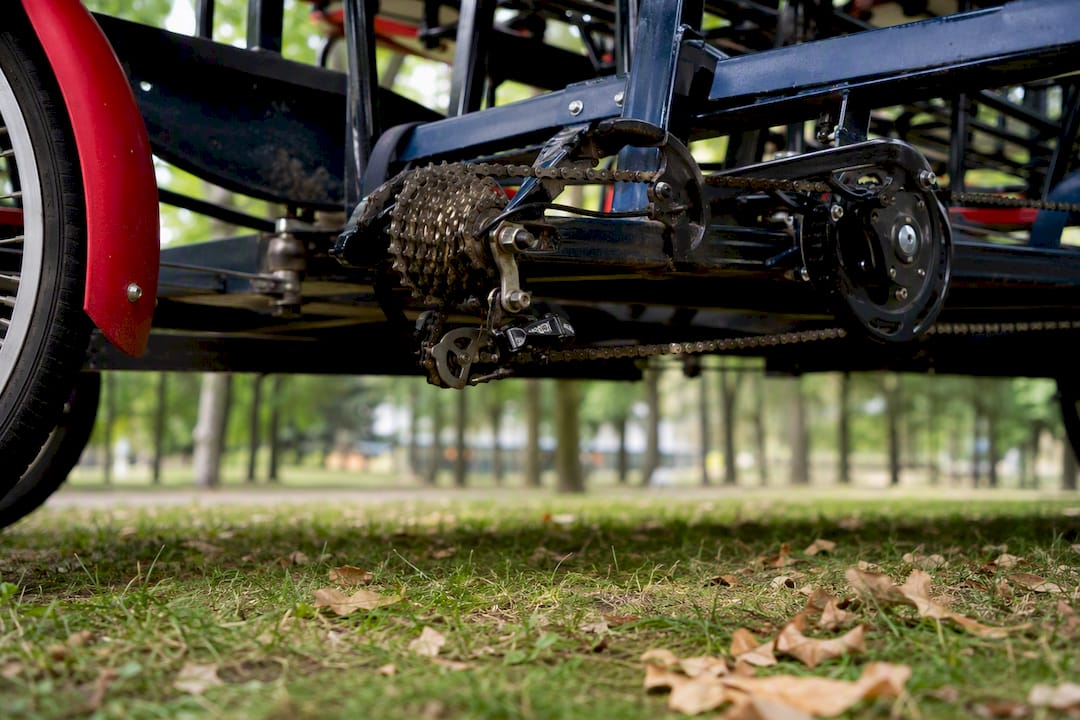
Most party bikes measure 15 to 20 feet long and about 7 feet wide, which is roughly the footprint of a large box truck. That size dictates a lot about how the vehicle handles: wider turning radius, longer stopping distances, and a driver who needs real training to manage both in traffic.
Capacity typically runs from 8 to 18 passengers plus the Captain, with bench seating arranged around a central bar or table where drinks get set down. Steering usually relies on rack-and-pinion or pinion-style systems, similar in principle to a car’s steering rack, connected to a wheel or handlebar at the driver’s station. That command position sits apart from the passenger benches, a deliberate design choice that keeps the person responsible for safety focused entirely on the road instead of the party.
- Frames are built from heavy-duty steel to support the combined weight of a dozen or more adults plus onboard equipment.
- Braking systems often include both a primary hydraulic or mechanical brake and a parking brake for stops.
- Street-legal units running on public roads typically carry headlights, taillights, turn signals, and side mirrors, matching standard vehicle equipment requirements.
- Canopy tops appear on many models, giving passengers cover from sun or light rain during longer routes.
Who Does What: Captain and Rider Roles During a Ride
The Captain is the one person on board not contributing pedal power, and that’s by design. Their job covers steering, braking, route navigation, and enforcing safety rules like keeping hands and feet inside the vehicle. They’re the primary safety officer for the entire trip, which is why reputable operators put drivers through structured training before handing them the wheel.
Riders have a smaller but still real job: keep a steady cadence, wear closed-toe shoes, and respond to the Captain’s verbal cues. A typical ride follows a rhythm like this:
- The Captain calls out before starting, giving riders a chance to get their feet on the pedals.
- On hills or at stop signs, the Captain may call for lighter pedaling or a full stop, and riders ease off together.
- Approaching a turn, the Captain signals riders to keep pedaling steady rather than leaning into the turn.
- At the destination, the Captain calls the stop and engages the brake before anyone unclips or stands up.
Pro Tip: If your group has a mix of pedaling enthusiasts and reluctant riders, rotate seating positions partway through the route so no single section carries the whole load uphill.
How Pedal-Assist Motors Change the Experience
Pedal-assist is exactly what it sounds like: an electric motor that only activates while passengers are pedaling, giving a boost rather than replacing the human effort. It’s not a throttle system. There’s no button that moves the bike on its own. The motor senses pedal rotation and adds torque proportionally, which matters most on inclines or when getting a loaded bike moving from a dead stop.
- Motors are sized for modest, continuous torque rather than raw power, since battery capacity and local e-bike regulations both cap how much assistance is built in.
- Assisted units can sustain slightly higher speeds with less rider fatigue, especially useful for mixed-fitness groups.
- Stop pedaling, and the assist stops too. Riders still need to keep their legs moving for the bike to go anywhere.
Staying Safe on a Party Bike: What to Check Before You Ride
Most incidents on party bikes trace back to a handful of preventable causes: distracted riders standing up while moving, poor brake maintenance, or a Captain who hasn’t been properly trained on a vehicle this size and weight. Reputable operators counter these risks with routine mechanical inspections, defined passenger limits, and Captains who’ve logged real practice hours before taking paying groups out.
Before booking, it’s worth confirming a few things directly with the operator:
- Does the company carry liability insurance for group tours?
- Is the Captain certified or formally trained on that specific vehicle?
- Are lights, reflectors, and mirrors present and functional for road use?
- Is there a clear, enforced maximum passenger count?
Worth knowing: Real-world testing of a 16-person pedal pub found that alcohol served on board adds a genuine layer of operational complexity, from managing open containers to keeping riders seated at stops.
Alcohol policy is the one area where you should never assume. Consumption-on-board rules and licensing requirements vary significantly by city and country, so check local regulations rather than trusting what you’ve seen on a bike in a different town. Some jurisdictions permit BYOB setups, others require a licensed server on board, and some ban open containers entirely.
What Riding a Party Bike Actually Feels Like
Forget any image of a grueling workout. Cruising speed on a standard pedal pub sits around 5 to 10 mph, which is closer to a relaxed stroll pace than a spin class. The pedaling is light, social, and easy to sustain across a route that typically lasts an hour or two, closer to a moving conversation than actual exercise.
A few things make the experience smoother:
- Wear closed-toe shoes. Sandals and flip-flops slip off pedals fast.
- Dress for the weather since most units are open-air, canopy or not.
- Pace your drinks. You’re still operating machinery with your legs, even at a walking pace.
- Match your cadence to the group instead of pedaling at your own rhythm.
- If seats without pedals exist on your model, take turns using them so nobody burns out early.
Pro Tip: Never stand up while the bike is moving, even to snap a photo. It shifts weight unpredictably on a vehicle this size and makes the Captain’s job harder.
Basic etiquette rounds it out: follow every Captain instruction without argument, stay seated between stops, and offer to swap into a pedaling seat if you notice someone flagging. A well-planned pub crawl tour builds in enough stops that fatigue rarely becomes an issue.
A Real-World Example: How Pedal Power Galway Runs Its Tours
Watching how an actual operator structures a ride fills in the gaps between mechanics and lived experience. Pedal Power Galway runs its pub crawl tours with clear meeting-point guidance so groups know exactly where to gather before boarding, and its tours archive lays out package types side by side, from hen and stag parties to corporate team-building outings.
- Booking pages list group size, duration, and route details upfront, no guesswork required.
- Themed packages, including collaborations with escape room challenges, give groups options beyond a straight pub crawl.
- Rider guidance emphasizes that pedaling is light effort suited to casual riders, not athletes.
That combination, transparent logistics plus realistic effort expectations, reflects how a well-run party bike operation should present itself before anyone climbs on board.
Book Your Own Party Bike Experience in Galway
Understanding the mechanics is one thing. Actually feeling a dozen pedals sync up as your group rolls past a pub crawl route is another. If your group is planning a hen party, a stag weekend, or a birthday that needs something more memorable than a standard bar crawl, Pedal Power Galway’s full lineup of tours covers pub crawls, sightseeing routes, and themed packages built around exactly the mechanics covered here. Groups weighing a party bike against other transport formats might also find it useful to compare notes with a private versus group tour breakdown before locking in a plan. Check available dates and reserve your seats directly through the booking page.
What the Mechanics Really Tell Us About Party Bikes
The technical details matter more than most people assume before their first ride. Understanding that a freewheel mechanism absorbs uneven pedaling explains why some rides feel smooth and others feel jerky, and it has nothing to do with your group’s fitness level. It’s about rhythm, not strength.
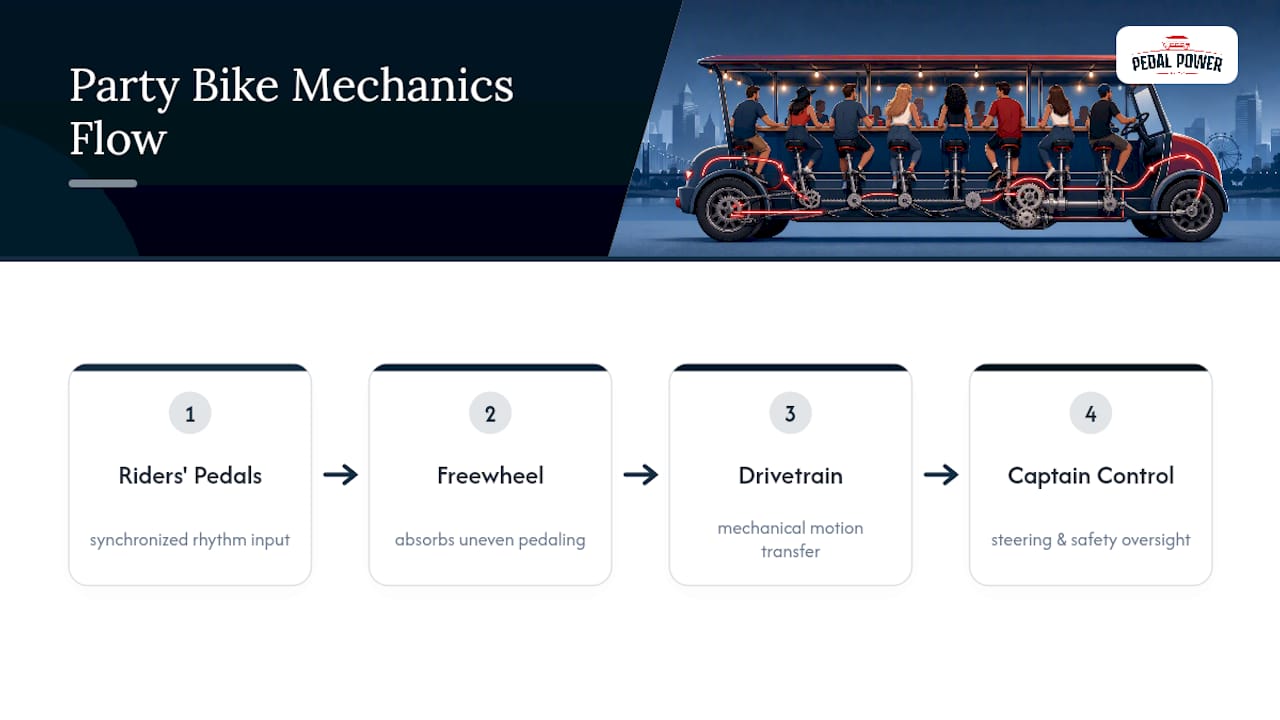
Where conventional advice falls short is treating party bikes as either “just a novelty” or “basically exercise.” Neither framing holds up. The mechanics point to something more specific: a low-effort, socially calibrated activity where the engineering, not the riders, does the heavy lifting of keeping things moving smoothly.
If there’s one thing worth prioritizing before booking, it’s operator transparency. A company that clearly explains Captain training, passenger limits, and alcohol policy upfront is telling you something real about how seriously it takes the mechanical and safety side of the ride. That matters more than the paint job or the theme.
Frequently Asked Questions
Do you actually have to pedal on a party bike?
Yes, on standard models. The vehicle only moves when passengers pedal together, though pedal-assist versions reduce the physical effort required.
How fast do party bikes go?
Most cruise between 5 and 10 mph, a relaxed pace closer to walking speed than cycling speed, making it an easy activity for mixed-fitness groups.
Does the driver pedal too?
No. The Captain’s role is steering and braking from a separate station, not contributing pedal power to the drivetrain.
Are party bikes legal on public roads?
Requirements vary by location, but many road-operating units carry standard vehicle equipment like lights, turn signals, and mirrors to meet local rules.
Can you drink alcohol on a party bike?
Policies differ by jurisdiction and operator. Always confirm alcohol rules directly with the company before assuming it’s permitted on board.
Sources
- Party bike — Wikipedia
- Beer run: We test the PedalPub, a 16-person alcohol-fueled party bike — Car and Driver
- What Is a Pedal Pub and How Does It Work? — Motrike
- Do You Actually Have To Pedal On A Pedal Pub? Essential Guide — EngineAuditor