

For a smooth group tour, pack your personal essentials and consolidate the group’s shared gear, then assign responsibility before anyone leaves home. The three communal items every group should prioritize are a first-aid kit, sunscreen, and a universal adapter with a power bank, each assigned to one named person so nothing gets forgotten or duplicated three times over.
TL;DR:
- Assign a single person to carry key communal items like the first-aid kit, sunscreen, and universal adapters to prevent duplication and omissions.
- Pack according to the itinerary, focusing on activity-specific clothing and footwear that is already broken in to avoid delays from blisters or unsuitable attire.
- Keep all travel documents, medication, and shared essentials in carry-on luggage, and confirm airline rules for power banks and adapters before departure.
- Use packing strategies like the 5-4-3-2-1 rule and neutral color palettes to minimize luggage and streamline shared room organization.
- Run a pre-trip group checklist to confirm everyone has their documents, medications, and assigned communal items to avoid common packing oversights.
Table of Contents
- Group-specific packing essentials: personal vs. shared items
- Clothing and footwear: pack by activity and weather
- Toiletries, health and safety: first-aid and medication handling
- Electronics and power: chargers, adapters, power banks and airline rules
- Packing methods for groups: 5-4-3-2-1 and related frameworks
- Itinerary-driven packing and travel documents checklist
- Top packing mistakes groups make and practical pro tips to avoid them
- Publisher perspective: lessons from running group tours
- Booking and organizer resources from Pedal Power Galway
- Sources
- FAQ
Group-specific packing essentials: personal vs. shared items
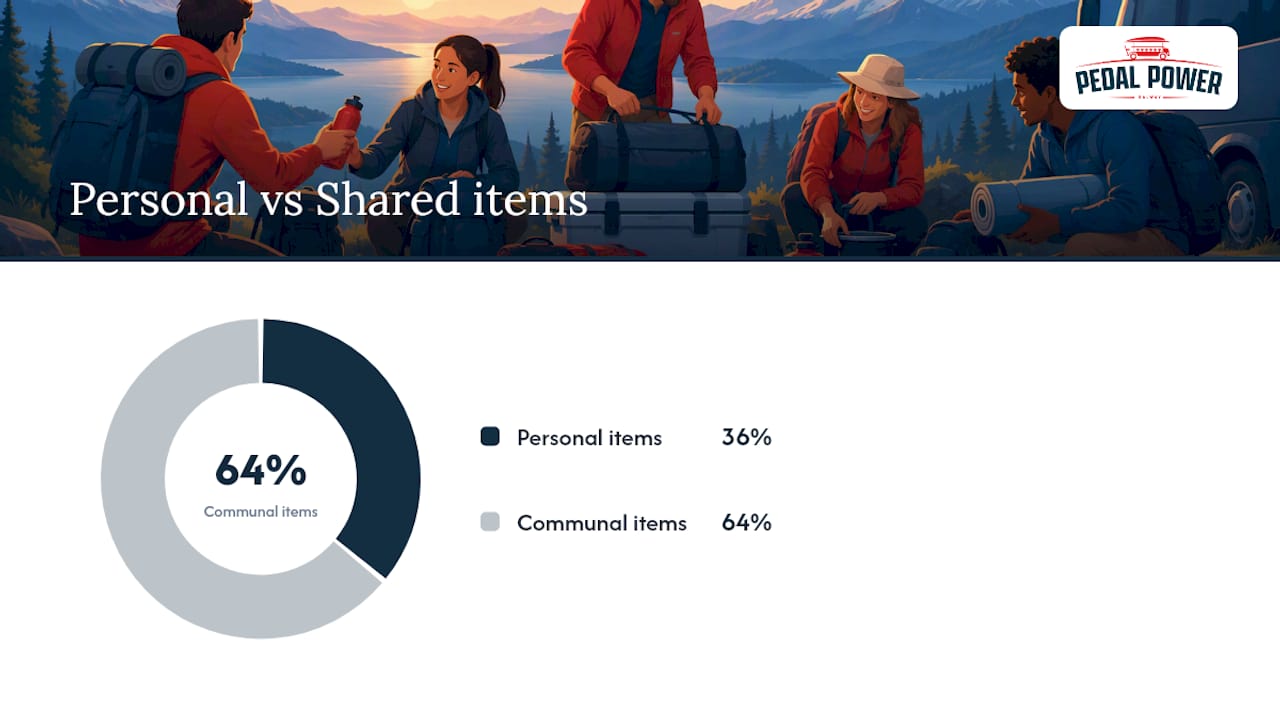
The fastest way to pack for a group trip is to sort everything into two piles: what belongs to you alone and what the group carries together. Personal items are the things only you can use, your passport, daily medications, underwear, and your own phone charger. Communal gear covers the stuff that gets used once and shared by everyone: a first-aid kit and universal adapters are the classic examples, along with sunscreen and a portable speaker.
The mistake most groups make is packing in isolation, so five people show up with multiple bottles of sunscreen and nobody with a plug adapter that actually fits the socket. A shared checklist fixes that before it becomes a problem.
Communal items worth consolidating on most group tours:
- First-aid kit, stocked for minor scrapes and headaches
- Sunscreen, one large bottle instead of five small ones
- Universal power adapter for shared devices
- Multi-port charger for hotel rooms with limited outlets
- Portable power bank
- Bluetooth speaker
- Laundry sheets or a small travel detergent pack
Each item on that list needs a name attached to it, not just a checkbox. Whoever packs the first-aid kit should carry it in their daypack for the day, and everyone else should know who that is.
Pro Tip: Send one message to the group 24 to 48 hours before departure listing every communal item and who’s carrying it. It takes five minutes and it prevents most of the “who has the sunscreen” arguments that happen on day two.
Clothing and footwear: pack by activity and weather
Clothing decisions get easier once you build them around the itinerary instead of guessing. If the trip includes a city walking tour, a beach afternoon, and one nicer dinner, pack for exactly those three situations and skip the rest.
Footwear is where group trips go wrong most often. New shoes worn for the first time on a ten mile walking day cause blisters, and blisters slow down the whole group, not just the person wearing them. Break in any new footwear for at least a week before travel.
A few packing tactics make shared rooms and quick mornings easier:
- Use packing cubes to separate clothing by day or activity so you’re not digging through a full bag before breakfast.
- Roll clothes instead of folding them to save space and keep wrinkles down.
- Stick to a neutral color palette so tops and bottoms mix and match without extra pieces.
- Bring one pair of broken-in walking shoes, one casual pair, and swimwear only if the itinerary calls for it.
Rolling and cubing aren’t just space savers, they also make roommate-shared bags easier to navigate, since everyone’s section stays visually distinct even when bags get packed together. For groups riding open-air party bikes or similar activities, comfortable layers that won’t catch on equipment matter more than anything fashionable, and our dress code guidance for party-bike outings covers what actually works on the bike.
Toiletries, health and safety: first-aid and medication handling
A small, well-stocked first-aid kit solves most minor problems on a group trip, especially in places where pharmacies aren’t always around the corner. Keep it in a daypack that travels with the group each day rather than buried in checked luggage.
A useful group kit includes:
- Adhesive bandages and blister plasters
- Antiseptic wipes or cream
- Basic pain relief medication
- Anti-diarrheal tablets
- Any allergy medication the group commonly needs
Personal medication is a different category entirely and it should never go in checked luggage. Keep daily prescriptions in your carry-on, and if you’re on something you can’t easily replace, pack a duplicate supply in a separate bag in case one gets lost.
Sunscreen and insect repellent work well as communal purchases, one large bottle per group instead of everyone bringing a travel-size version that runs out by day three. The same pooling logic applies to full-size toiletries: shampoo, conditioner, and body wash rarely need five separate bottles when four people are sharing a bathroom. Groups planning activities with physical risk, like team-building days or adventure outings, should also look at a risk assessment template to figure out what belongs in the first-aid kit before departure.
Electronics and power: chargers, adapters, power banks and airline rules
One universal adapter and one multi-port charger can cover an entire group if you plan the rotation instead of everyone bringing their own. That alone cuts down on bulk and on the inevitable moment someone forgets theirs at home.
Power banks need more attention than most travelers give them. Power banks and spare lithium batteries are generally required to travel in carry-on baggage, not checked luggage, and airlines apply their own limits on top of the general baseline. That single rule catches more travelers off guard than almost anything else on this list.
A few practical points to check before you fly:
- Confirm the watt-hour (Wh) rating printed on your power bank, since most banks rated 100 Wh or under are typically accepted in the cabin, but some airlines set stricter limits.
- Pack power banks in your carry-on, never in checked bags.
- Bring one compact multi-port USB hub per room to solve the “not enough outlets” problem that shows up in almost every hotel.
- Set up a nightly charging rotation so devices aren’t fighting for the same two sockets.
Hotel rooms booked for groups often have far fewer outlets than people, so a shared multi-port charger paired with a simple rotation solves the problem without anyone needing to buy a second adapter.
Packing methods for groups: 5-4-3-2-1 and related frameworks
Minimalist packing formulas work especially well on group trips because they force you to travel lighter while the group handles the shared essentials. The best known is the 5-4-3-2-1 rule: five tops, four bottoms, two pairs of shoes, two layers, and one bag. It’s built for trips of up to two weeks where you’re willing to do laundry roughly once a week, and it keeps everyone at carry-on size, which matters when a group is trying to move through an airport or hop between stops without waiting on checked bags.
For shorter trips, a tighter version called the 3-5-7 rule scales the counts down, while longer trips might expand each number slightly rather than abandoning the structure entirely.
A few habits make either method work better:
- Stick to a single color palette so every top matches every bottom.
- Plan on doing laundry once during the trip instead of packing sixteen shirts.
- Wear your bulkiest shoes and jacket while traveling instead of packing them, freeing up bag space for everything else.
Itinerary-driven packing and travel documents checklist
The itinerary should drive the packing list, not the other way around. Break the trip into its actual events and pack for those specifically instead of guessing at a generic list.
- City walking day: comfortable shoes, daypack, refillable water bottle, sun protection.
- Beach or water activity: swimwear, quick-dry towel, waterproof phone pouch.
- Hike or outdoor excursion: layered clothing, sturdier footwear, snacks, a filled water bottle.
- Formal dinner or event: one nicer outfit, appropriate shoes, that’s usually the only formal piece needed for a whole trip.
Documents deserve their own short list, and they all belong in your carry-on, never checked: passport, travel insurance details, emergency contact information, and a printed copy of the itinerary in case phones die or lose signal.
Before departure, run a quick group cross-check: everyone confirms out loud (or in the shared chat) that they have their documents, their assigned communal item, and their personal medication. It takes two minutes and catches almost every gap before it becomes a problem at the airport.
Top packing mistakes groups make and practical pro tips to avoid them
Most group packing problems trace back to the same handful of mistakes, and each one has a quick fix.
- Over-packing: stick to a formula like 5-4-3-2-1 and resist the extra “just in case” outfit.
- Ignoring destination sockets: check the plug type before you leave, not after you land with a dead phone.
- Meds in checked luggage: keep daily prescriptions in your carry-on, always.
- No coordination on shared items: assign a named owner to every communal item before anyone packs a bag.
- Unbroken-in shoes: wear new footwear for at least a week before the trip.
Pro Tip: Label communal items with a piece of tape and the owner’s initials, keep a photo of everyone’s passport and insurance card in a shared cloud folder, and wear your bulkiest jacket on travel day instead of packing it.
A final one-minute check before leaving the house: documents in carry-on, meds in carry-on, communal item assigned and packed, phone charged, itinerary saved offline.
Publisher perspective: lessons from running group tours
Running group activities day after day teaches you where packing breaks down. Outlet shortages in shared rooms and a missing communal item, usually sunscreen or the one adapter everyone needed, cause more delays than anything dramatic. Groups that assign an owner to each shared item and keep a simple checklist handle it without drama. It’s a small habit that saves a surprising amount of friction once a group actually gets moving.
— Pedal
Booking and organizer resources from Pedal Power Galway
Once the packing list is sorted, the next question for most organizers is what to actually do once the group arrives. Group tours built around large party bikes can benefit from coordination habits like one shared list and one named owner per task, which work well both for packing and activity planning.
A few options that fit different kinds of groups:
- The 1 3/4 Hour Pub Crawl Tour, priced at €50 per person, suits groups who want a guided night out without the packing headaches of a full day trip.
- The Qube Challenge v’s Pedal Power, priced at €70 per person, works well for corporate teams looking for a structured team-building day.
- The full tours listing covers birthday tours, longer pub crawls, and other formats for groups of varying sizes.
Organizers planning meals or snacks for the group might also find value in general advice on eating well while traveling or in ideas for durable shared snacks that hold up over a full day of activity. Reach out through the tours page to check availability and talk through a custom booking for your group.
Sources
The guidance above draws on group travel checklists and coordination strategies from Tripstogether, packing formulas from Travel Checklist, organizer systems from WhenInYourCity, and power bank rules from The Pro Toolkit. Always confirm airline and destination-specific rules before you travel, since they can change.
- Group travel packing checklist — Tripstogether
- What is the 5-4-3-2-1 rule for packing? — Travel Checklist
- Power-bank airline carry-on rules — The Pro Toolkit
FAQ
What is the 5-4-3-2-1 rule of packing?
The 5-4-3-2-1 rule limits your packing to five tops, four bottoms, two pairs of shoes, two layers, and one bag. It’s designed to maximize outfit combinations while keeping you at carry-on size for trips up to two weeks, assuming you do laundry about once a week.
What is the 3-5-7 rule in packing?
The 3-5-7 rule is a tighter version of minimalist packing formulas, scaling item counts down for shorter trips rather than packing the full 5-4-3-2-1 count. Definitions vary slightly between sources, but the core idea is the same: fewer days mean fewer items across each clothing category.
What are the 5 biggest packing mistakes to avoid?
The most common mistakes are over-packing, ignoring destination-specific plug types, packing essential medication in checked luggage instead of carry-on, failing to coordinate shared items across the group, and bringing shoes that haven’t been broken in. Most of these come from packing alone instead of coordinating with the group ahead of time.
What is the most forgotten item when packing for vacation?
Chargers, adapters, and sunscreen are frequently the items groups forget or unnecessarily duplicate, since everyone assumes someone else is bringing one. Assigning a named person to each shared item before departure is the most reliable way to avoid the gap.