

A group event risk assessment is a written record of the hazards at your event, who could be harmed, and the controls you’ll put in place to stop that happening. The first move isn’t research. It’s opening a blank form and logging the event date, venue, expected numbers, and organizer contact, then working through the five-step method below before you book a single supplier.
TL;DR:
- A formal risk assessment is essential for any gathering where harm to multiple people could occur, covering all event phases from build-up to breakdown.
- Officials expect it for insurance claims, venue contracts, and to guide emergency communication, especially for crowded public events under Martyn’s Law.
- Use a five-step process: identify hazards, assess who is at risk, evaluate existing controls, document findings, and regularly review and update the assessment.
- Control specific hazards such as structures, weather, fire, fuels, and food vendors through documented proof of inspection, certifications, and proper storage.
- Keep the risk assessment a living document, updating it for site changes, incidents, or new contractors, and conduct a post-event review for continuous improvement.
Table of Contents
- What Does a Group Event Risk Assessment Actually Cover?
- Why Bother With a Formal Risk Assessment?
- The Five-Step Method, Explained Simply
- Building Your Checklist and Sample Form
- Assessing Crowd Safety and Venue Fit
- Controlling the Hazards That Cause the Most Harm
- Keeping the Document Alive After the Event
- Choosing Templates and Tools to Manage the Process
- What Running Group Tours Has Taught Us About Risk
- Sources
What Does a Group Event Risk Assessment Actually Cover?
A risk assessment isn’t the same document as a full event safety plan. The safety plan covers everything from parking to waste management; the risk assessment is narrower, focused specifically on hazards, harm, and controls. HSE guidance on assessing crowd safety treats it as the foundation the wider plan builds on, not a replacement for it.
You need a written assessment any time people gather in numbers large enough that something going wrong would hurt more than one or two people. That covers a small corporate team day just as much as a large festival. The scope also spans the whole lifecycle, not just the hours the event runs:
- Build-up: rigging, deliveries, generator siting, and structure erection carry their own hazards before a single guest arrives.
- Live show: crowd movement, weather changes, and equipment failure need real-time monitoring.
- Breakdown: fatigue, reversing vehicles, and rushed dismantling cause a disproportionate share of incidents.
Each phase gets its own line of thinking in the assessment. Skipping breakdown because “the event’s over” is one of the most common gaps organizers leave.
Why Bother With a Formal Risk Assessment?
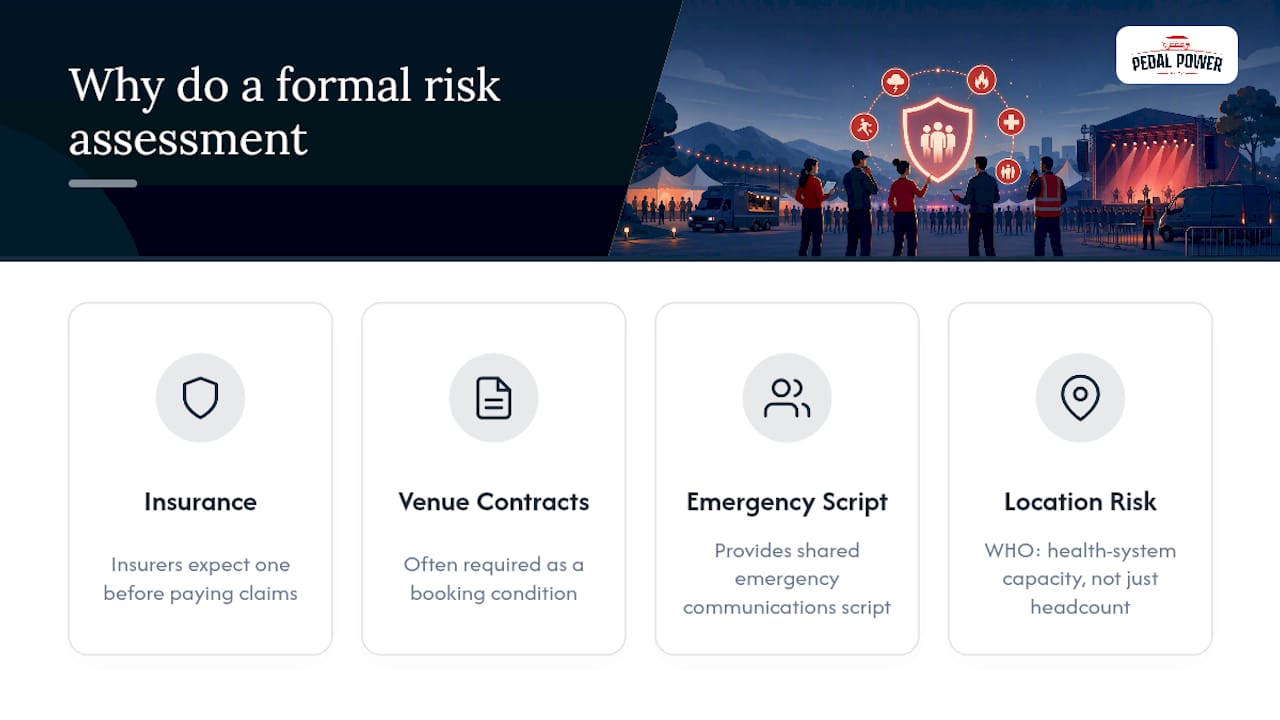
Insurers expect one before they’ll pay a claim without a fight, and most venue contracts make it a condition of the booking. Beyond the paperwork, a documented assessment gives your team a shared script for emergency communications rather than everyone improvising in the moment.
For any event in a crowded public space, organizers now also need to weigh terrorism-related vulnerabilities under Martyn’s Law, the Terrorism (Protection of Premises) Act 2025. It’s not a separate exercise. It sits inside the same hazard log as your fire and crowd-crush entries.
Statistic callout: The World Health Organization’s mass-gatherings risk tool frames readiness around host-location health-system capacity, not just headcount. That means a 2,000-person event in an area with one small clinic carries a different risk profile than the same crowd near a major hospital, even before you touch a single crowd-control measure.
The Five-Step Method, Explained Simply
HSE’s standard approach breaks the work into five steps. Run through them in order, and don’t skip step five just because the event date has passed.
- Identify hazards. Walk the site or floor plan and list anything that could cause harm: trip hazards, generators, alcohol service, vehicle movement, weather exposure.
- Decide who might be harmed. Staff, contractors, attendees, passersby, and vulnerable groups (children, wheelchair users, people with hearing impairments) each need a separate mention, since the same hazard affects them differently.
- Evaluate the risk and existing controls. Rate each hazard by likelihood and impact, then note what’s already in place to reduce it.
- Record your findings. Write it down. An assessment that lives only in someone’s head doesn’t survive a staff change or an insurer’s request.
- Review and revise. Treat the document as live, not a one-time form to file away.
For step three, a simple 3×3 matrix works for most group events: rate likelihood and impact each as Low, Medium, or High, then multiply. A high-likelihood, high-impact hazard (crowd crush at a narrow exit, say) jumps to the top of your control list ahead of a low-likelihood, low-impact one (a minor trip hazard in a rarely used corridor).
Each hazard row should capture:
- The hazard itself, described specifically (not “electrical,” but “generator cabling crossing a pedestrian route”)
- Who’s at risk
- Current controls and any additional action needed
- Who owns the action and by what date
- The residual risk rating once controls are applied
Building Your Checklist and Sample Form
A usable form doesn’t need to be complicated. It needs the right fields, filled in consistently. Council templates, including East Cambridgeshire’s event risk assessment guidance, consistently point organizers toward the same core structure.
Your checklist should include:
- Event details and organizer contact information
- Site plan or venue layout
- Full hazard list with ratings
- Control measures for each hazard
- Stewarding and first-aid provision
- Contractor RAMS (Risk Assessment Method Statements) and insurance certificates
- A communications plan for emergencies
| Field | What to record |
|---|---|
| Event basics | Date, venue, expected attendance, organizer contact |
| Hazard description | Specific source of harm, not a generic category |
| Who’s at risk | Staff, attendees, contractors, public |
| Control measure | Action taken to reduce likelihood or impact |
| Residual rating | Risk level after controls applied |
| Action owner | Named person, not a department |
Scale the detail to the event. A 30-person birthday tour needs a lighter document than a 3,000-person street festival, but the fields stay the same. Keep a printed copy onsite and a digital backup, ideally shared with whoever’s running the event day.
Assessing Crowd Safety and Venue Fit
Your audience profile shapes almost every other decision. A hen party group moves and behaves differently than a corporate away-day crowd, and steward numbers should reflect that rather than a flat ratio applied to every booking.
Zone the site before the event, not during it. Map entrances, exits, and the routes emergency services would need if something went wrong. HSE’s crowd safety guidance flags surging and pinch points as the hazards organizers underestimate most, particularly at narrow gates or where two crowd flows merge.
Keep vehicles physically separated from pedestrian routes wherever possible, and identify pinch points early enough to widen them or add stewarding.
- Set a safe capacity figure and don’t let bookings exceed it
- Confirm at least two viable exit routes for any indoor space
- Walk the emergency-vehicle route yourself before the event, don’t assume it’s clear
Pro Tip: Call the venue owner or local emergency services a week out, not the day before. A five-minute conversation about access routes has saved more than one event from a last-minute scramble.
Controlling the Hazards That Cause the Most Harm
Some hazards show up on nearly every event risk assessment, and they deserve specific, named controls rather than a vague “monitor closely” note.
- Temporary structures: require a structural certificate and inspection sign-off before use, every time, regardless of how many times you’ve used the same marquee.
- Weather: set a wind-speed threshold in advance for cancelling or securing structures, not a judgment call made in the moment.
- Fire and pyrotechnics: keep exclusion zones and extinguishers matched to the specific risk, not a blanket one-size fits all placement.
- Generators and fuel: store fuel away from crowd areas and ignition sources, with clear signage.
- Food service: confirm food-hygiene certification from any vendor before they set up.
None of this works if contractors show up without proof. Ask for RAMS, public liability insurance, and competence certificates before granting site access, and verify them against a checklist on arrival rather than trusting a phone assurance. The Purple Guide frames this documentation as a coordination tool between venue, contractors, and emergency services, not paperwork for its own sake.
Keeping the Document Alive After the Event
A risk assessment that never gets updated is worse than no assessment at all, because it creates a false sense of coverage. Version and date every revision, get sign-off from whoever’s accountable, and share the current version with the landowner or venue manager so there’s a clear audit trail if an insurer asks.
Re-run the assessment whenever:
- The site layout or attendee numbers change
- You bring on a new supplier or contractor
- A near-miss or actual incident occurs
Praxis42’s guidance on conducting event risk assessments treats the document as living rather than fixed, updated after site visits and contractor confirmations, not just once a year.
After the event, run a short debrief covering attendance, incidents, near-misses, supplier performance, what worked, and who owns each follow-up action. That fifteen-minute conversation is the fastest way to make next year’s assessment better than this year’s.
Choosing Templates and Tools to Manage the Process
Start with an official template rather than building one from scratch. HSE’s guidance and council toolkits like East Cambridgeshire’s both offer structures you can adapt without reinventing the wheel.
Spreadsheets work fine for smaller events and are easy for suppliers to fill in offline. Collaborative platforms earn their keep once you’re managing multiple contractors or a large team, since everyone edits the same live document instead of emailing versions back and forth.
- Look for offline access, since site walks often happen without signal
- Confirm the tool exports an audit trail, since insurers and venues may ask for one
- Share the template with contractors early, so their RAMS align with your format rather than arriving in an incompatible layout
- A day-of group chat or messaging tool, like TextMyGuests for attendee updates, complements the written assessment rather than replacing it
What Running Group Tours Has Taught Us About Risk
Running pedal-powered tours through a city center for years teaches you one thing fast: the paperwork only matters if it changes what happens on the road. We check every contractor’s RAMS and insurance before they touch our schedule, and we verify it again the morning of, not just when the file first lands. A group chat app running live on event day catches the small stuff, like a road closure or a late arrival, before it becomes the big stuff.
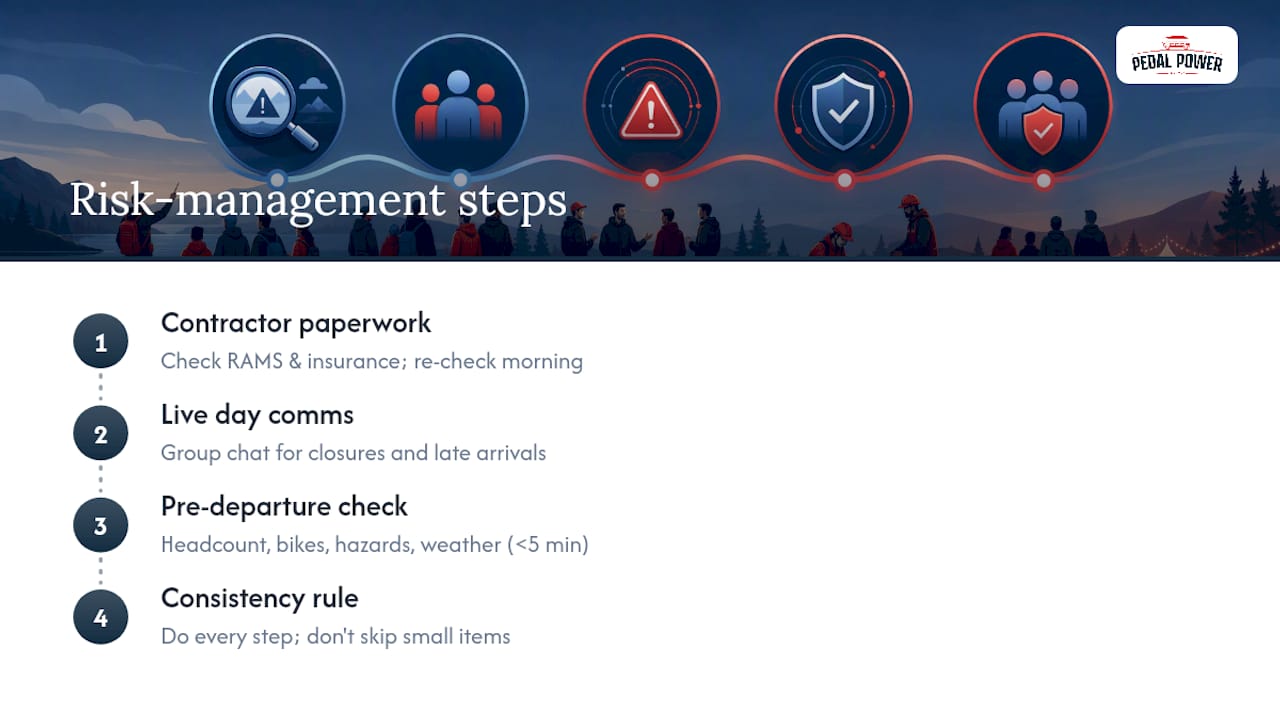
Our pre-departure checklist runs through headcount, bike condition, route hazards, and weather in under five minutes, every single tour. Consistency beats complexity. The teams that get into trouble usually skipped a step they thought was too small to matter.
If you’re planning a group event in Galway and want to see how a live-run team handles this in practice, our tours page shows how we structure a booking around exactly this kind of prep, and our visit planning guide covers the logistics side for larger groups.
— Pedal
Sources
- Assess crowd safety risks and identify hazards – HSE
- The event safety guide (The Purple Guide)
- WHO mass gatherings risk assessment tool (2023)
- How to conduct an event risk assessment | Praxis42